Recently I’ve found myself thinking about the state of pharmacy technology. Why? Simple, really. I’m bored and have been doing a little extracurricular reading. Not to mention that a few things have popped up here and there to pique my interest. It’s not one single piece of technology but rather a collection of technologies and interactions I’ve had over the past 18 months.
I think it started with EdgeX, a new technology for tracking things. An old acquaintance reached out to me “to pick my brain”. You know how that goes. I’ve had two trusted and respected mentors during my career that told me to never let someone “pick your brain” or “buy you a cup of coffee”. Apparently it’s code for can I get something out of you for free. With that said, I have no reason to hold out on anyone. I had my chance.
Then came Compounding360, a product by Pharmacy Stars. Nothing new, but an approach that caught on with a lot of people. The healthcare system I work for decided to implement Compounding360. Even though I wasn’t involved with the process, it was installed at my facility, which meant I had to become familiar with it.
Two people contacted me about blogs that I wrote years ago.
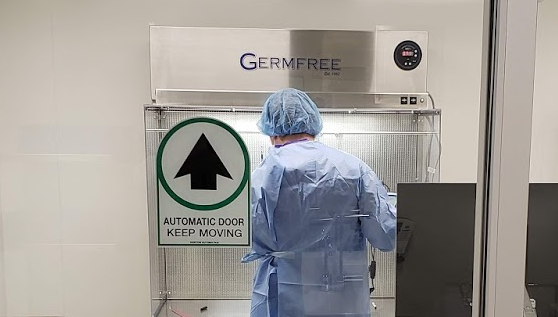
I received an email advertisement for a new “smart hood”, which I attended. A product that more than captured my attention. I worked on something similar in the 2010-2012 era.
I received another email advertisement for a product that uses AI to detect poor sterile compounding technique. Again, something I had worked on in the same time period as the item above. I need to dig out my notebooks and find exactly when I was musing about these things.
I read something on LinkedIn, a place I almost never go, about DoseEdge sunsetting sometime in the next few years. Yet another thing I wrote about a years ago.
And most recently, I had a brief email exchange with someone I met over 10 years ago when I was working for Talyst.
It wasn’t until I found myself thinking about these things deeply that it hit me, are we really starting to see movement in pharmacy technology? Maybe. Or it could simply be that this has been going on around me continuously and I failed to notice. The latter is probably more true than the former, but I have no way of knowing. I’ve been locked into dreadfully boring work for the past 6-7 years, so the world of pharmacy technology may have been growing steadily this entire time.
One thing that I find thrilling is many of these products were ideas and concepts we had long ago. I recall working on a “smart hood” more than a decade ago. I can remember sketching out hoods to detect poor sterile compounding using Microsoft Kinect (remember the Kinect?). Compounding360 is a platform that has been designed many times by many companies in one form or another. My brother, Robert and I discussed the use of “geofencing” with cellular technology to track health care items back when the first iPhone came out, which reminds me of what EdgeX is doing. It may not be exactly the same, but the concept is similar.
As they say – I don’t know who “they” are but they certainly say a lot – timing is everything. Perhaps the timing simply wasn’t right back then. Regardless, it’s cool to see some of these things finally becoming reality.
From January 2020 until March of 2022, I was one of two inpatient pharmacy supervisors at Community Regional Medical Center (CRMC) in Fresno, California. CRMC is a big level one trauma center. They have about every imaginable service, minus only bone marrow and solid-organ transplants. The pharmacy is large and busy. The size and complexity of the place generated plenty of opportunities to make changes, test out new processes, and work through complicated patient care issues.
Thinking back, you will note that COVID-19 was in full swing during my time at CRMC, especially during late 2020 and throughout 2021. The fallout from the virus created some interesting problems for pharmacy, namely supply chain issues and increased patient acuity, resulting in increased workload. One particularly troublesome issue was the strain that COVID-19 put on CRMC’s sterile compounding service. The inability to get product, combined with increased demand for certain types of infusions, wreaked havoc on the department.
In response, our team did some interesting things to simplify, streamline, and improve IV production during this time. The work was some of the best I had ever done. I felt so good about it that I thought others might like to review the process. I thought someone might be able to learn from our successes and failures. So, along with a couple of colleagues, I decided to write what I thought would be a publishable article. Turns out there’s a reason I started a blog more than a decade ago instead of trying to push information through mainstream publications.
The article manuscript was uploaded to the AJHP portal and sat for quite some time. Once the review process began, it wasn’t long before it was summarily rejected. Not “hey, fix these things and we’ll publish it”. Nope, a straightforward “we regret to inform you…”. Apparently, the information wasn’t worth publishing. Some of the comments received from reviewers were valid, and worth consideration, but others were quite silly. Someday, I might post the reviewer comments here just to see what others think. However, right now I’m irritated, so it doesn’t seem like a great idea.
Overall, I found the reviewers comments lacking in basic understanding of what goes on day-to-day in a large inpatient pharmacy. Some of the comments — “What type of inventory adjustment occurred when usage patterns changed?” – had me scratching my head. Had these folks ever worked in a real pharmacy? I mean, adjusting inventory isn’t rocket science. Ask yourself what happens when your family starts going through two gallons of milk every week instead of one. You buy more milk. Or, for empty nesters like me and my wife, when you hardly ever need milk anymore, you only buy it when you need it. Common sense, people. Common sense.
Anyway, my original intent for the article was to disseminate information to those that might find it useful. So, for those people, I’m including it here in its entirety, warts and all. With that said, the article is written in a more formal tone than my normal writing, which honestly makes it more difficult to fully understand. All told, the necessary information is probably a 1-page weblog. Regardless, I hope you get something out of it. Happy reading.
Oh, one thing that I think is important but got left out of the article is how manual the processes were that we used to improve our sterile compounding. Shocking, really. My love of technology and automation offered no benefit here. Healthcare – and by association pharmacy – is so disjointed and fragmented that I quickly abandoned any attempt to automate this project. Simple, manual tasks continue to rule the day.
Pulling another article from the notebook archive, penned March 20, 2020.
I have seen the future of IV workflow management systems (IVWFMS). Spoiler alert, EPIC wins. And before people start calling me an Epic fanboy, I should make it clear that I do not like Epic, as a company or a product. I believe healthcare will rue the day they relinquished all their power to a single company.
Those that know me or have read anything I have written in the past decade, know that I am an advocate for technology in the IV room. People are imperfect creatures, they make mistakes. Don’t believe me? Google Emily Jerry death or St Charles rocuronium. That will tell you all you need to know about the dangers associated with injectable medications. Compounded sterile preparations are the most dangerous medications within the four walls of a hospital. Seems logical that such dangers would receive the utmost attention. Inexplicably, they do not. Many reasons are given for ignoring the issues, but it boils down to poor planning and the inability to prioritize in the face of budgetary and political restraints.
Technology, while far from perfect, adds a level of protection to a complex, error-prone, and dangerous process. Adding a little common-sense technology to the IV medication process, like an IVWFMS*, is the quickest and most cost-effective way to improve safety.
Implementing these systems is a no-brainer, but that hasn’t stopped people from ignoring them. The problem has been, at least from my perspective, a complete failure by pharmacy leadership to recognize and prioritize IV room safety and efficiency. Nowhere else but in the IV room can a single mistake result in significant harm or death. Yet the IV room seems to get a fraction of the attention it should. Unfortunately, it often takes a tragic error like those noted above before folks take notice.
With that said, there is some good news. I have witnessed an uptake of IVWFMS in recent years. More hospitals seem to be adding these systems to their workflow. While a welcome trend, the increased numbers don’t appear to be secondary to some altruistic good will or common sense, but rather because of Epic. The monolithic EHR vendor has unwillingly changed the landscape of the IVWFMS market, forever. Big pharmacy technology companies refuse to admit it, but the writing is on the wall. When asked what technology a hospital is using in the IV room, I used to hear “nothing” or “DoseEdge” with an occasional “MedKeeper” thrown in. Now, more often than not, I hear “Dispense Prep”.**
Why the shift? No mystery here, the answer is simple: the barrier to entry is low and the integration within the platform is amazing.
For healthcare systems already using Epic, it is as easy as flipping a switch. The implementation requires a bit of legwork, and some minor equipment, but nothing like that required when implementing a third-party system like DoseEdge, BD Cato, etc. I have been involved with both Epic and third party IVWFMS implementations, there is little comparison in time, energy, effort, and cost. Epic Dispense Prep (EDP) wins in all those areas, easily, every single time.
The ease of EDP implementation is tied directly to the modularity and integration of the overall system. It shares databases, labels, user experience, dashboards, and so on. EDP is already part of the EHR, so it requires no additional contracts, no additional maintenance agreements, no third-party vendor helpdesks, no “integration” within the EHR, no crazy implementation schedule and checklists, no weird upgrade schedule or downtime, and so on.
EDP implementation requires far fewer pharmacy resources than other IVWFMS and has the added benefit of being nearly transparent to pharmacy personnel. Most of the build is handled behind the scenes by dedicated IT resources — the ever present Epic Willow Build Team. Pharmacy resources are kept to a minimum, which decreases impact on the department. Contrast this to something like DoseEdge, which requires a significant investment in time and effort from pharmacy personnel. I can attest from personal experience that the overhead for a third party IVWFMS implementation can be hundreds of hours of dedicated pharmacist time. EDP, on the other hand, requires a fraction of that time. This alone makes it an easy choice for pharmacies strapped for resources, which describes nearly all inpatient pharmacies.
None of this means that EDP is the best IVWMS on the market. Not even close. While it offers full integration across the entire enterprise, barcode scanning, image capture, robust tracking, and is seamlessly tied into the billing system — something I care little about but is a top priority for healthcare systems — it falls short in other areas. As I write this, I can think of at least three products off the top of my head that I believe are better than Dispense Prep. They are more flexible, more feature rich, have better hardware, have better software, and so on. Most even eclipse EDP in the quality of the basics, like image capture. But it doesn’t matter if they are never implemented. The best IVWFMS is the one you are using. While Dispense Prep may not be the best, it is better than nothing. Love the one you’re with, you know?
While not an accident per se, I believe Epic won the battle of IV workflow management systems without trying. Several large IDNS have already converted to Epic, giving them an obvious competitive edge in the IV room. As facilities with Epic gravitate toward Dispense Prep for the reasons outlined above, the market will inevitably begin to contract, forcing third party vendors to compete against one another for a smaller piece of the pie. It may take some time – things always do in healthcare – but companies marketing IVWFMS will feel the pressure. I believe some already have. I have personally witnessed facilities that have uninstalled DoseEdge in favor of EDP, and some that have elected to with Epic over an outside vendor. The pressure is on.
To the IVWFMS out there, I wish you good luck. The long game is not in your favor.
===========================
*Robotics has its place in the IV room. Products continue to get better every year. While it may not be for everyone, I can see use cases where robotics would be a viable option.
**EPIC Dispense Prep (EDP) is the IVWFMS module inside the Epic EHR System. It is an incredibly well integrated piece of the overall Epic medication distribution model. Dispense Queue [a dashboard of everything waiting to be prepared] → Dispense Prep [capture all data during compounding] → Dispense Check [Pharmacist Review] → Dispense Tracking [track product from pharmacy to bedside]. While I do not care for Epic, in general, one has to admire the vision and design.
I saw the discussion below in one of the pharmacy forums. Fact check true on this one.
Gilead would have everyone believe that remdesivir is a magic bullet for COVID-19 infection. Not true. Helpful? Useful tool? Maybe.
Remdesivir, while potentially beneficial, has limitations. For one, it should only be used on hospitalized patients that have falling oxygen saturation and chest infiltrates. Second, while it has been shown to potentially shorten the course of the disease, it has not been shown to reduce mortality.(1)
On the flipside, the drug is relatively expensive, has been overused, and contrary to data showing that it may shorten the course of the disease, may inadvertently lengthen hospital stays.
Based on the “Solidarity†trial, a WHO guideline committee went as far as to recommend against the use of remdesivir.(2)
“The Solidarity Trial published interim results on 15 October 2020. It found that all 4 treatments evaluated (remdesivir, hydroxychloroquine, lopinavir/ritonavir and interferon) had little or no effect on overall mortality, initiation of ventilation and duration of hospital stay in hospitalized patients… So far, only corticosteroids have been proven effective against severe and critical COVID-19. [see RECOVERY trial (3)]… The researchers determined the evidence quality to be low for remdesivir in regard to improving time to clinical improvement, hospitalization duration and mechanical ventilation duration.”
However, you won’t find physicians touting this particular WHO recommendation. Why not? Simply put, it doesn’t fit the narrative put forward by Gilead and the media. Nor does the WHO recommendation give practitioners access to this new therapeutic toy. A combination of marketing and fear has led to remdesivir rapidly evolving into “best practiceâ€. It is basically spreading through hospitals unchecked.
But Jerry, no hospital could have predicted the pandemic and therefor the cost of remdesivir. True. However, if remdesivir truly cut hospital stays by a couple of days and reduced time on mechanical ventilation, the cost of the drug would be a wash. I have not seen any large-scale data to support this notion. As of today, hospitals have spent millions upon millions of dollars on remdesivir. Not to mention that there are reports of providers prolonging patient stays to complete remdesivir treatment courses even when patients have met criteria for discharge. Such practice spits in the face of common sense.
But Jerry, even if it saves one life it will have been worth it. Ah yes, the battle cry of people who want something done, regardless of the consequences. Such sentiment seems reasonable on the surface, but quickly fades with analysis and thought. A philosophical debate for another time. Suffice it to say that real life doesn’t work that way.
Overall, the unfettered use of remdesivir, combined with failure of healthcare to provide clear, concise, science-based use criteria, has created a budget pitfall that will take years to climb out of, if at all. It’s this type of fiscal irresponsibility that makes the U.S. healthcare system so special.
———-
Healio.com. 2021. Remdesivir shortens time to improvement, but has no significant mortality effect. [online] Available at: <https://www.healio.com/news/primary-care/20210331/remdesivir-shortens-time-to-improvement-but-has-no-significant-mortality-effect> [Accessed 29 April 2021].
Who.int. 2021. “Solidarity†clinical trial for COVID-19 treatments. [online] Available at: <https://www.who.int/emergencies/diseases/novel-coronavirus-2019/global-research-on-novel-coronavirus-2019-ncov/solidarity-clinical-trial-for-covid-19-treatments> [Accessed 30 April 2021].
New England Journal of Medicine, 2021. Dexamethasone in Hospitalized Patients with Covid-19. 384(8), pp.693-704.
What’s a 503B FDA outsourcing facility? Well, just sit right back and you’ll hear a tale, a tale of a fateful trip, that started from this tropic port, aboard this tiny ship…. just kidding, it’s what popped into my head when I started writing, but we really should define what a 503B is.
The 503B moniker is a designation created by the FDA that establishes a middle ground between manufacturers and facility-level compounding. In short, 503Bs are pharmacies that can “manufacture” compounded medications and sell them to other entities, like hospitals. Unlike hospital pharmacies, designated 503A pharmacies, 503Bs must comply with strict CGMP (current good manufacturing practices) which are the same standards that pharmaceutical manufacturers are held. Because 503Bs use CGMP and conduct lots of sterility and stability testing, they are allowed to assign extended beyond-use-dates (BUDs) to products. It is a tough gig to be sure, no one wants to be beholden to the douchebags at the FDA. More information on 503Bs can be found here.
In general, 503Bs were born out of the crazy overregulation of pharmacy IV rooms. The adoption of USP General Chapter <797> by Boards of Pharmacy throughout the land created a void for most pharmacies that could not easily be filled. Unlike in the heyday of pharmacy practice, when pharmacists made sound, logical decisions based on science, education, and experience, the current landscape dictates when and how something can be made, its storage conditions, and ultimately how long it can be held prior to use. Before USP <797>, it was customary practice to compound “batches” of frequently used medications and store them for future use, whether that be a week or a month down the road. It was the lifeblood of many pharmacies as it gave them control of their own resources. During downtimes, staff would batch in anticipation of times when things were so busy you could not take a piss. With adoption of USP guidelines as best practice, this all went away. Compounding on demand, with some low volume “anticipatory compounding”, became the norm.* It is quite inefficient compared to older, better practices.
The issue above created a hole in the pharmacy supply chain that gave rise to 503Bs. It’s a service that no one asked for but became unavoidable for many. Don’t get me wrong, 503Bs have been of great benefit to many healthcare systems. They provide a vital service between pharmaceutical manufacturing and facility-level compounding. There are hospitals out there that would find it difficult to survive without 503Bs. On-demand compounding with small anticipatory batches is always preferred, but not always possible. Everybody needs help sometimes.
However, 503Bs are not perfect, and their shortcomings were amplified during peak pandemic. In general, one would have a need, place an order, and receive drug. But we all know that the pharmacy supply doesn’t always work this way. In fact, it’s all too common to have a need, place an order, and then sit around wondering what happened to the drugs that were supposed to be sitting in your receiving area. Things can get messy in a hurry. Think for a moment about when 503Bs are needed most. It’s when demand is high and pharmacies are running at peak capacity. Unfortunately, it’s during these times of critical need when 503Bs become a liability.
In short, here are the reasons why using 503Bs is a mistake:
Expensive: You pay for the convenience of purchasing products made by someone else. They have to pay for labor, testing, and infrastructure somehow. I do not begrudge them their profit, but it has to come out of someone else’s pocket. For large facilities, this can easily add up to a number north of a million dollars per year. A million dollars is not exactly earth shattering for facilities with budgets in the tens of millions of dollars, but it is worth a moments consideration.
Shortages, demands, delays: 503Bs suffer from the inability to spin up production during times of extreme need. Rest assured, when one pharmacy has increased need for a certain drug, they all do. This obviously creates issues with supply chain, and nowhere is this more evident than with 503Bs. It’s bit me on the rear more than once.
Quality control issues: Unfortunately, 503Bs are subject to the same quality control issues that are found in many pharmacy IV rooms. One small error can force the destruction of an entire batch, which may represent orders for many pharmacies. Whoops, get ready for an Excedrin-sized headache.
Customer support: My limited dealings with 503Bs has resulted in me wanting to deal with them even less. I have found customer support at 503B companies to be lacking, to put it kindly.**
In the end, it is at one’s own peril that they rely on 503Bs to provide a steady stream of products. They seem to let pharmacies down when they are needed the most. After much thought, I think it is time for pharmacies to take back control of their compounded medication production. While not the easiest thing to do, USP guidelines, and by extension most regulatory agencies, do allow pharmacies to produce limited quantities of compounded products in anticipation of need. Given the potential expense of using 503Bs, it seems logical that one could find enough in cost savings to build out a new service line. This is especially true for facilities large enough to require such a service in the first place.
And that brings us to robotics, which is a blog for another time.
————————-
*one may technically compound large batches at the facility level, but it is limited by two factors: 1) it requires extensive testing that is time consuming and expensive, and 2) regulatory agencies like the CA Board of Pharmacy and the California Department of Public Health (CDPH) hate it, so they tend to crawl up every orifice you have searching for a problem if you do it. It’s the type of scrutiny facilities try to avoid.
**I believe this is due to the nature of their business model, i.e. razor thin margins made up by cranking out more product.
Quite some time ago I took to writing things down in a paper rather than digital notebook. This morning, as people will do when they are bored, I picked up one of those notebooks and began thumbing through the pages. Not too far in, I came across some notes dated Sunday, April 5, 2020 that form the foundation of this blog post.
As we enter year two of “two weeks to flatten the curveâ€, the notes I jotted down in April 2020 remain relevant. What I thought would be a short kneejerk overreaction, turned out to be quite long. Fortunately, at least in California, the predicted impact of COVID-19 never manifested. To date, our healthcare system has never been in danger of being overrun. In contrast, many facilities ran with patient loads less than average throughout most of 2020. The same remains true for the early months of 2021.
The “lessons†outlined below represent individual opinions, nothing more. They’re my thoughts from April 2020, with some updated experiences thrown in for good measure. Honestly, it is more about healthcare and people than it is “the virusâ€.
The pharmacy supply chain is broken. With hospital census numbers falling throughout most of 2020, the struggle to keep up with basic supplies became a real grind. Shortages are nothing new, but the problem was amplified during the pandemic. Personal Protective Equipment (PPE) became especially problematic, particularly for large facilities with cleanrooms. PPE was worth more than gold in the early months on the pandemic. Everyone scrambled to provide basic gear for IV room personnel. Reasons for the extreme shortage were many. A majority of PPE being made outside the country, fewer people available to work in production plants secondary to illness, and increased use were all factors. However, hoarding cannot be overlooked. Facilities were buying “as much as they could get†and stockpiling. It was a real problem.
Patient care became political. At no point in my career have I seen such a draconian dictation of what therapies could or could not be used. Historically, medication selection is based on physician’s professional judgement coupled with experience. That all changed in 2020. Legitimate, potentially beneficial treatments became political hotbeds. Physicians have always been the tip of the spear when caring for patients. They see things the rest of us don’t, which often gives them insight into treatment approaches. I’ve seen things throughout my career that I thought should never have been used but were. It often boiled down to “what they doctor wantedâ€. Not in 2020. Providers were denied therapies that were not “mainstreamâ€. Normally, I’d get immense pleasure out of watching a physician turn into a 3-year-old that’s been told they can’t have a popsicle for dinner, but not this time.
2020 exposed pretenders. I was shocked at the panic displayed by many healthcare providers. When things got tough, instead of rising up, they folded. The metal of which people are made becomes clear when the pressure is on. It’s often not pretty.
The approach for treating any disease evolves over time. Some things work, some don’t. Experience counts. COVID-19 has proven no different. Patients are doing better now because treatment has evolved. With that said, COVID-19 became the first disease in memory to have treatment dictated by reasons other than data. That’s a precedent no one should be celebrating.
Scientific literature died in 2020, and it will never be the same again. Instead of sharing information and ideas, it became political. In 2020, open discussion and thoughtful debate was traded for political correctness. Studies or opinions that dissented from mainstream political views were simply not tolerated. Articles were pulled. Commentary was written. Pop-up warnings were added to online journal articles that proposed alternate theories.
Healthcare systems were not prepared. The pandemic exposed many weaknesses in hospital practice. So much for “mass casualty preparedness” lauded by hospitals everywhere. See what I said above about the metal from which people are made. It became obvious in the early days of the pandemic that many in healthcare leadership have no metal at all. I saw much panic, flailing, paralysis, and poor decision making throughout 2020.
Healthcare forgot that other diseases existed. I simply stopped reading pharmacy forums and gave up on healthcare related websites. There was no reason to visit. Everything written was related to COVID-19. The same questions and commentary, day in and day out. It was monotonous and unnecessary. It’s a good thing all other illnesses and healthcare-related issues took a hiatus in 2020.
Media in general, but more specifically social media, replaced idea sharing, science, and data with politics. What a mess. I gave up on social media in 2020 – ironic that I’m sharing this online, right? There is no intellectual value left in social media, only hate-spewing, intolerant individuals.
Healthcare systems are technologically inept. No surprise here, I’ve been saying this for years. The arrival of COVID-19 exposed healthcare’s technology-last approach. Nowhere was this more evident than when “remote work†became a thing. Excluding telehealth, “remote work†for many healthcare systems was a joke. As someone that spent the better part of his career “working remotelyâ€, I can tell you that it can be done, given the right equipment and infrastructure. Not in healthcare. “Here’s a laptop, you’ll be working remotelyâ€. Good luck with that. Not everyone is cut out for remote work. Many lack the focus, attention, and discipline to make it work.Â
Over regulation. Does anyone doubt that healthcare is a regulatory nightmare? I cannot speak about other states, but the California Board of Pharmacy and Department of Public Health (CDPH) proved themselves inept and tone-deaf during the pandemic. I could go into details, but it would probably cost me my job, so I’ll just leave it at that.
Waste. I will never again worry about “the environmentâ€. Why bother? Given the millions of tons of unnecessarily wasted PPE that is surely piling up in landfills somewhere, I will never worry about what I toss in the trash. Day after day, I walked past trash receptacles full of used masks, booties, goggle, and gowns. Daily! The waste generated by any large facility in a week far exceeds my lifetime allotment of garbage. So please don’t pander to me about “saving the planetâ€.
Last year reminded me of all the reasons I left hospital pharmacy and spent a chuck of my career exploring other options. Healthcare is a mess and COVID-19 did nothing to improve it.
COVID-19 has taught us many things, among them that our healthcare supply chain is poorly designed and flimsy. Just a few weeks into the pandemic and our supply chain for Personal Protective Equipment (PPE) has been completely disrupted. PPE is now in short supply, and I suspect that we will run out of PPE in just a few weeks if things continue on their current trajectory.
Are we using more PPE because of COVID-19? Of course! But we are unable to spin up production because a vast majority of the products we need are not made in the United States and the world is in lock down. An industry that is literally designed to provide care to others and save lives has no supply chain redundancy, no failover strategy for shortages, and no geographical diversity for equipment and supplies.
Any pharmacy that compounds sterile medications – intravenous antibiotics, for example – is required to wear a lot of PPE. Guidelines have lead to staff being required to wear a clean, low-lint gown, bouffant (head cover), mask, shoe covers, and sterile gloves when entering the buffer area of a pharmacy cleanroom; I also have to wear a beard cover, but most do not.
When leaving the area, a vast majority of the aforementioned PPE gets tossed, i.e. wasted. Up until about a week ago, much of the PPE worn by pharmacy personnel could not be reused. Now, because of the pandemic, regulatory agencies are lifting these restrictions. It’s an interesting shift in thinking.
In general – in theory? – the use of PPE during sterile compounding is designed to decrease risk of introducing bioburden into process. I suppose that makes sense. Unfortunately, the risk has never been quantified to any appreciable manner. There are no before and after statistics to determine whether or not strict adherence to PPE guidelines has done anything to improve sterile compounding safety, or lesson the risk of contamination. One thing is does, however, is generate a ton of waste and increase the cost of sterile compounding significantly .(1)
Current garbing practices are basically at the whim of groups like the United States Pharmacopeia (USP). The process by which USP creates these guidelines is not at all transparent. We have no idea what thought and/or research goes into their recommendations. Unfortunately, USP guidelines are frequently – almost universally – adopted in whole or part by other regulatory agencies like Boards of Pharmacy, Departments of Public Health, The Joint Commission (TJC), and so on. Few ever question the decisions because everyone is too busy trying to follow the rules and take care of patients to fight it.(2)
Over the past couple of weeks, organizations and regulatory agencies have been pulling back on the requirements for sterile compounding PPE, due in no small part to the disruption in the supply chain caused by COVID-19. It’s an evolving situation.
As we move through this crisis, I recommend the following:
Review your current PPE practices. Some folks are doing way more than is required. While noble on the surface, doing so is adding to the shortage and not necessarily benefiting anyone. Â A prime example is pharmacies that use full PPE in anterooms.
Re-use PPE when allowed. See most recent USP recommendations here.
Do not place re-used PPE in plastic bags for safekeeping. I saw this recommendation somewhere and it makes no sense to me. People perspire in PPE, and zipping it up in a bag is akin to a makeshift incubator.
Sign up for USP, TJC, and local Board of Pharmacy email communications. Things are changing rapidly, at least they have been here in California. We’ve had to make several adjustments over the past 7-10 days, and I expect we’ll have to make even more in the coming weeks. It’s going to get weird.
Use common sense. Folks, pharmacists are highly trained, specialized professionals. Now is not the time to be averse to making judgement calls. It’s why we spent all those years in school and get paid the big bucks. Use your head. Be smart but be flexible.
———–
It is not uncommon for large hospital pharmacies with busy cleanrooms to spend more than $10K per month on disposable PPE. Think about that the next time a hospital administrator complains about spending $3K on a “non-formulary†course of therapy
Recently, a group successfully blocked the publication of new USP <797> guidelines. One of the reasons the group went after USP was due to lack of transparency in their process and failure to provide information when comments and requests were ignored.
I’ve been slowly reading ‘Thinking, Fast and Slow’, a best-selling book by Daniel Kahneman, a Nobel Prize winning psychologist and economist known for his work on the psychology of judgment and decision-making.
The book summarizes behavioral science research conducted by Kahneman. The recurring theme of the book is what the author defines as two modes of human thought, “System 1†and “System 2â€. System 1 is fast, instinctive, and emotional. System 2, as you might guess, is slower, deliberate, and logical. The author spends a lot of time discussing how System 1 and System 2 impact choices and judgment, creating an incredible amount of bias in our decision making process. The basic thesis being that people really don’t have as much control over their decisions as they believe. According to Kahneman, humans constantly fall into predictable thinking traps, often due to the fast and emotional System 1. The concept is philosophically interesting but practically devastating.[1]
One section of the book that I found particularly compelling, and applicable to pharmacy, was Chapter 13, ‘Availability, Emotion, and Risk’. The chapter goes into great detail about how bias impacts decisions, even when presented with facts to the contrary. According to Kahneman, these biases are warped by media coverage, especially for emotionally charged issues. This creates problems because the average person is driven more by emotion than reason. [2]
This area of the book hit home for me because of my current involvement in a massive project to bring hospital pharmacy cleanrooms into compliance with new USP <797> and <800> guidelines. The entire project is the direct result of decision bias surrounding sterile compounding.
If one were to go back and research the impetus for developing current sterile compounding guidelines, one would be hard pressed to find anything concrete. Current USP Chapters <797> and <800> are based more on “expert opinion” than science. If it were the other way around, one would find more references for specific requirements and fewer reader comments. The guidelines would read more like a journal article and less like best practice recommendations. However, that’s not what we find in these chapters.
While there’s nothing wrong with expert opinion, per se, they should not override common sense. Expert opinions should be considered recommendations and guidance, not requirements and law. The problem with expert opinion is that it can be influenced by emotion, the same as an average person. Emotional decision making can lead to problems. According to Kahneman, “…biased reactions to risks are an important source of erratic and misplaced priorities in public policy. Lawmakers and regulators may be overly responsive to the irrational concerns of citizens, both because of political sensitivity and because they are prone to the same cognitive biases as other citizensâ€.
Consider this, Kahneman describes something in his book called an availability cascade. An availability cascade is “a self-sustaining chain of events, which may start from media reports … and lead up to public panic and large-scale government action. …[the] emotional reaction becomes a story in itself, prompting additional coverage in the media, which in turn produces greater concern and involvementâ€. This describes perfectly the current state of sterile compounding regulation in pharmacy.
Remember a little thing in 2012 that caused outrage aimed at pharmacies across the country? For those of you that don’t recall, Google New England Compounding Center (NECC). In summary, people died as the result of fungal meningitis caused by contaminated steroid injections compounded by NECC. It was pretty bad. The incident lead to congressional hearings, more power being granted to the FDA, increased scrutiny by regulatory and licensing agencies, and ultimately, more pharmacy regulation. Pharmacy is still reeling from the impact that the NECC tragedy had on the profession.
Here’s the thing, it was a horrible, terrible, no good tragedy, but it had nothing to do with lack of regulation. The folks at NECC simply chose to ignore best practice and place profit ahead of common sense and standard safety precautions. Lest we forget, USP <797> was already on the books in 2012. Would NECC have followed standard sterile compounding processes in place at the time, we wouldn’t be having this discussion today.
A single event, the NECC tragedy, was championed into significant changes without objective analysis. Why? According to Kahneman, we have “a basic limitation in the ability of our mind to deal with small risks, we either ignore them altogether or give them far too much weight…..biased reactions to risks are an important source of erratic and misplaced priorities in public policy. Lawmakers and regulators may be overly responsive to the irrational concerns of citizens, both because of political sensitivity and because they are prone to the same cognitive biases as other citizensâ€. That’s a perfect description of the current sterile compounding climate. Unfortunately, there’s no going back. As one prominent sterile compounding consultant told me, that ship has sailed. The only thing we can do now is be more prudent with decisions moving forward.
Think of the resources that have gone into cleanroom construction, training, and testing since the NECC incident. It’s staggering. Now think of what other pharmacy initiatives could have been implemented with the same resources. Based on risk alone, patient safety would have been better served by putting the same effort toward improving sterile compounding accuracy instead of sterility.
—————————————-
[1] Please read the book. It contains little tests and puzzles that will blow your mind. I thought I had solid command of my thinking. I thought my decisions were logical and well reasoned. I was wrong.
[2] Paul Slovic, a professor of psychology at the University of Oregon and the president of Decision Research stated that people are “guided by emotion rather than by reason, easily swayed by trivial details, and inadequately sensitive to differences between low and negligibly low probabilitiesâ€.
Full disclosure, anyone reading this should take it with a grain of salt. I used to work for Talyst as a product manager for their acute care product line, and I’ve recently been involved with a Pyxis Logistics implementation. With that said, forward.
In short, yes, BD Pyxis Logistics (“Logistics) is quite good. BD is doing something that pharmacy has needed for a long time, embracing the concept of “the enterprise†with integration across multiple areas in and out of the pharmacy. BD, as a company, has been busy over the past few years piecing together products to create a cohesive strategy. Someone has been paying attention.
Are they there yet? Not yet, but they are on their way. To paraphrase my brother, they’re currently the worst they’re ever going to be, i.e. their products and strategy are only going to get better and mature over time.
You’ve heard me talk about the four areas of pharmacy many times: standard storage, refrigerated storage, controlled substance storage, and the iv room.
Basic storage are those basic shelving units that most people think of when they walk into a pharmacy. It’s where you’ll find unit-dose and bulk room-temperature items. Logistics is squarely focused on this area of the pharmacy. It works well and, at least in my opinion, does a good job of addressing inventory across multiple pharmacies. Throw in that Logistics is web-based, and it’s compelling.
Refrigerated storage is, well, where you put things when you want to keep them cold. Same as basic storage, only refrigerated. BD doesn’t offer anything specific for this area, but Logistics handles refrigerated items just fine. It basically treats refrigerators the same way it treats static shelving and carousels. It’s just another storage area.
Cleanroom/IV Room is where you’ll find all the supplies for compounding sterile medications. The IV room has been getting a lot of attention lately, but that has nothing to do with inventory management. Most pharmacies treat the IV room as a black hole for inventory, i.e. they lose visibility of their inventory when it crosses the threshold into the land of sterility., BD has had a product called Cato for many years. It’s now called BD Pyxis IV Prep and I’ve always been a fan. Pyxis IV isn’t fully integrated with Logistics, but they’re working on it.
Controlled substance storage is where you’ll find all your opioids, benzodiazepines, and so on. Anything the DEA, Board of Pharmacy, and any other regulatory agency considers a diversion risk. I have a love-hate relationship with controlled substance management. This area is long overdue for improvement. With that said, I’m happy to report that BD is making inroads. The latest version of their CII safe software is integrated with Logistics, meaning no more disparate systems for controlled and non-controlled meds.
What I like about Pyxis Logistics
Multiple pieces of the pharmacy puzzle. When looking at the BD Pyxis lineup, the four areas of pharmacy are closer than ever.
Integration that is getting better and better all the time. BD not only has the pharmacy covered — Logistics, CII Safe, IV prep — but think about their dominance in the automated dispensing unit (ADU) market. Integration is hard, but getting ADUs and pharmacy inventory seamlessly talking to one another is something I’ve been pining after for a long time. Â
Handhelds. BD offers a handheld for Logistics. I haven’t had one in my hands but the device and functionality look good, shortening the inventory gaps even more. Talyst had a handheld device for AutoPharm years ago. Wonder what became of it?
Good folks to work with. I have nothing but good things to say about the people from BD that I’ve worked with. They want to do a good job.
Improvements are rapid and obvious. That’s the thing about most companies, they want to improve their products and keep customers happy. Improved products and happy customers equal increased adoption, which in turn leads to more sales, which leads to more money, and so on down the rabbit hole.
What I don’t like about Pyxis Logistics
Reports and analytics appear weak. The system offers many canned reports and access to the company’s Knowledge Portal, but overall, it feels like they’re behind in this area. From what I’ve seen, it’s just not there. When compared to something like the analytics software from Swisslog — still don’t know the name of the product…. Pharmacy Analytics? I mentioned it here — it feels miles behind. What’s worse is that what I saw at ASHP Midyear back in December doesn’t make me feel any better about it.
Piecemeal products. It’s obvious what BD is doing. However, buying products and folding them into your portfolio can make things feel like they’re bolted on instead of feeling like they’re an integral part. It’s only going to get better, but one has to be willing to ride through the rough patches to get to the smooth road.
Lack of product maturity. “Pyxis”, the ADUs, is a very mature product that’s used in thousands of facilities. Logistics and IV Prep, not so much, and it feels like it.
Overall, it seems as though BD is heading in the right direction. It will be interesting to see where the company ultimately goes with their strategy.
Several years ago,
shortly after I was let go from Talyst, I found myself with some free time on
my hands. I started writing a book. The book was titled ‘Making the right
choice: Helping pharmacies make smart decisions about automation and technology’.
Like many books I’ve started, it remains unfinished. I don’t think I’ve touched
it since 2016. At least that’s the date I have listed as the last time I edited
it. However, I recently had reason to go back and review some things I included
in the book. Kind of a retrospective review of advice to myself.
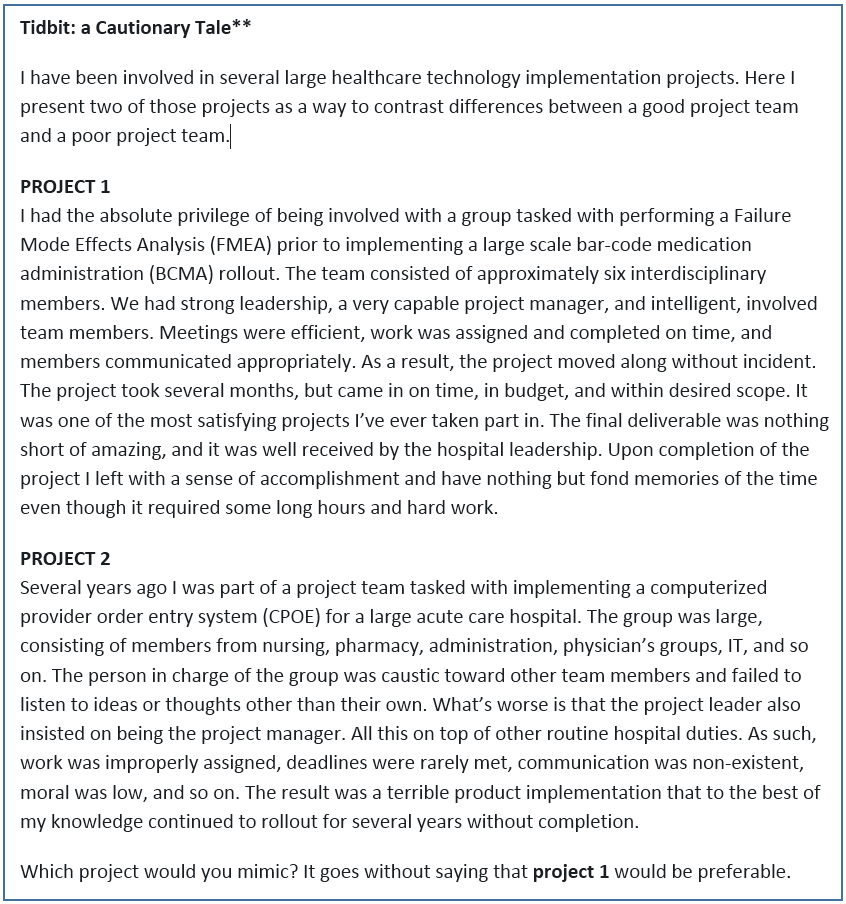
Specifically, I was interested in my thoughts on putting together a project team and managing a project. And there, in Chapter 8: First things first, I found what I was looking for. Some of the information is outdated, specifically the final page called Cautionary Tale**, but overall the information still rings true.
Here it is,
Chapter 8 in it’s draft form. Maybe one day I’ll get around to finishing the
book. One never can tell.
Chapter 8: First things first
“You can do anything…but before you can do anything, you have to do something.†— Clifford Cohen
You can’t get
to the end of a project if you never start, and getting started can often seem
like the most difficult part of any project. I can’t pinpoint why it’s so hard
to get started, but it is. Perhaps it’s fear of the unknown, or unwillingness
to move away from comfort zones. Or maybe it’s because we don’t want to do the
work. Who knows? The only thing I know for sure is that once the ball gets
rolling, no matter how slowly, it always seems to roll forward. The key is to
stop putting it off and get started.
With that
said, it’s important that one is truly ready to move forward. Understanding the
reason(s) for doing something is key. Seems simple, but it might surprise you
to learn how often people do things without understanding why. Begin the process
with eyes wide open. Never do anything simply for the sake of doing something.
One must be
able to justify all projects, regardless of their purpose. Simply put, the
project must worthwhile, viable and affordable, bring a reasonable return on
investment (ROI), and be within acceptable tolerances and risks.
Ask yourself these three questions:
What do I hope to accomplish?
Does the technology make sense?
Does the technology fit my operations
If you’ve
answered the above questions to everyone’s satisfaction, it’s time to get
busy.
Below are the
things that I think are important to ensuring a successful technology implementation
in a pharmacy. While it may seem like a lot of work, the end result will be
worth the time and energy.
Gauge user
beliefs and feeling. Is
it going to be an uphill battle? Are the pharmacists and technicians open to
the idea of implementing new technology? Is the pharmacy morale where it should
be? Does your department fear change? The success of your implementation will
rely heavily on how well you and your department are prepared. The
implementation of new technology can often pose a threat of reduced control
over one’s work. This can create pushback from the staff. Helping them
understand what it is you hope to accomplish, how it will help them, and
offering opportunities for staff to become involved and have a vested interest
in the project can go a long way to ensuring a successful implementation.
Get
support / buy-in for the project.
The need for support for any project is a must, and this is especially true for
pharmacy projects. Success depends on support from the top of the organization
to the bottom. Lack of support will result in a failure to launch. If and when
possible, it is best to start with an executive sponsor, or someone from the
Hospital Board of Directors, if you have one. This person, or persons, will be
your champion during high-level meetings within the organization.
Once you have
executive level support, it’s time to consider support from other areas. If the
project will impact nurses, find a nurse. If a physician, find a physician.
And, so on. You don’t want to launch a project that will impact a group of
people without getting their support. Trust me, it’s not a good idea. Call it
politics if you must, but peer-to-peer communication works wonders. Having
support from a variety of areas and disciplines will improve communication and
go a long way in generating support for a project.
Create a
buzz. Create some
excitement. Don’t act like the project is required, but rather a choice that’s
going to make things better.
Give
everyone fair warning of what you plan to do. People fear change. Give them plenty of time to get
used to the idea. This will go a long way in gaining support for a project.
Being aware of what’s coming is always preferable to being surprised by what
has already been done.
Involvement
and participation. When
individuals believe that a project is relevant, they are much more likely to have
a positive attitude toward it. And the best way to get individuals to believe
is to get them involved. Allow them to participate in all phases of the
project. “Increasing user participation … enhances post-development user
involvement and attitude†(Vaughan PJ. System implementation success factors;
it’s not just the technology. Internal Report of Information Technology
Services. University of Colorado at Boulder. 2000), which is what you
want.
Involve as
many as you can as often as often as you can. When people are involved, it
gives them a sense of ownership and a vested interest in making a project
successful. It also helps deal with negative vibes from others. Include
multiple disciplines, depending on the technology and departments affected.
It is also
important that all participants be volunteers. Mandated participation has been
shown to be ineffective and potentially detrimental to the success of this type
of project. (Hunton, James E., and Jesse
D. Beeler. “Effects of User Participation In Systems Development: A
Longitudinal Field Experiment”. MIS Quarterly 21.4 (1997): 359.
Web. 8 Apr. 2016.)
Champions.
Champions are those people
that go above and beyond the general participant. Champions believe in the project
and the benefits it will provide. They can often have a contagious zeal about
the project, and are sometimes referred to as “evangelistsâ€, or in extreme
cases “zealotsâ€. Whatever you call them, when it comes to implementing new
technology in the pharmacy, Champions can be your best source of support. They
can be useful in putting a spotlight on the project in a positive way and
swaying the negative feelings of others.
Finding
Champions shouldn’t be too difficult. They’re usually early adopters and will
take the initiative to learn more about a project without being asked.
Develop rules for participation. This is really quite simple. It is important that the rules for participation be laid out well in advance, and that each member of the team sign off on them. There should be no surprises for what’s expected from participants once the project is underway. The following rules are examples:
Be willing and able to engage in the
project
Be willing to be positive about the
project
Be willing to work with others to
advance the project toward accomplishing the goal
Be willing to commit to attending
meetings
Be willing to commit to handling extra
work, even if it means staying late or doing some reading at home in the
evenings or on weekends. I understand that no one wants to put in a bunch of
unpaid overtime on these projects. However, on occasion, a little extra work may
need to be done to keep things moving forward. One should enter into
participation with the understanding that this could happen.
Be willing be engage in every aspect
of the project, not only the items that are assigned. It is vitally important
that each participant have at least a basic understanding of the overall scope
of the project and what each member of the team is assigned. Things happen.
People get sick, quit their jobs, move to another state, and so on. Unforeseen
events should not completely derail the project timeline or goals.
Find
naysayers and sway them over to your side. Every project has its opposition. As the saying goes,
you can’t please everyone all the time. Unfortunately, naysayers tend to have vocal
personalities. They’re not afraid to say what’s on their mind. These two things
– being negative and outspoken – tend to go hand-in-hand. The downside to
naysayers is that outwardly negative comments about a project have a way of
spreading like wildfire. They can be caustic, seeping into the minds of even
the staunchest supporter. And once there, negative thoughts can grow like a
cancer. With that said, naysayers and their negative comments have their place.
Because they’re not afraid to speak up, they can sometimes point out things
that others fail to see, helping avoid potential pitfalls. The trick is to use
the information to your advantage. Allow naysayers to offer up their thoughts
in a controlled environment where their comments can be contained. Give them
space to vent. Listen to what they have to say. Use what you can and toss the
rest. Showing naysayers that you’re willing to listen and take their concerns
seriously can go a long way. In rare cases, you might even make a convert out
of one, which would be a huge victory for the project. However, never try to
force change on a naysayer. Forcing change, or mandating them to join your side,
rarely works. It’s like dealing with a donkey, the harder you pull, the harder
they resist.
Build your team. According to Harvard Business Review’s (HBR’s) 10 Must Reads On Emotional Intelligence[(HBR’s 10 Must Reads On Emotional Intelligence. Print.), a source of great team success lies with teams that can achieve high levels of participation, cooperation, and collaboration among members. Sounds logical, but oh so difficult to do.
Note: HBR’s 10 Must Reads On Emotional Intelligence is a great collection of previously written articles pulled together into a single book. Each article is informative and interesting in its own right. However, when combined, they create a great collection that any person involved in a project should read. I highly recommend it. It’s a short book and an easy read.
Team
members must be chosen carefully and meet three basic conditions:
Mutual
trust of one another
Have
a sense of group identity: a feeling that they belong and the project is
worthwhile
Have
a sense of group efficiency: belief that the team can perform well and that the
group is better than the individual members.
Collectively,
HBR refers to this as the groups “emotional intelligence†(EI). While intelligence
and experience among group members is important, EI may be more important
still. Keep that in mind when you begin building your project team.
Chose
a project leader. Ah,
the leader. The captain. Thy person in charge. It’s a burden that many well
qualified individuals shy away from. Someone has to be in charge. Someone has
to be given authority over the group and be willing to make the tough decisions
and hold people accountable.
Not
everyone is cut out to be a leader. Everyone reading this has worked for both
great and terrible leaders. While I cannot tell you exactly how to identify a
great leader, I know one when I see one.
According to HBR’s10 Must
Reads On Emotional Intelligence
what distinguishes good leaders from great ones is their EI. For individuals,
EI is “a group of five skills that enable the best leaders to maximize their
own and their followers’ performanceâ€.
The
EI skills are:
Empathy
Motivation
Self-regulation:
controlling negative impulses [side note: this is really hard to do, especially
during high-stress times]
Self-awareness:
knowing strengths and weaknesses
Social
skill: being able to build a rapport with others to get desired results {side
note: especially tough if you’re a natural introvert]
Find
yourself a project manager. As
ridiculous as this may sound, the project manager is an often overlooked
position when discussing project teams. Let me go on record now as saying that
a good project manager is absolutely vital to the success of any project, and
could arguably be considered the linchpin to the success of the entire project.
It
is the job of the project manager to manage all aspects of the project,
including the scope, timeline, cost, quality, and people. They apply their
knowledge, skills, tools, and techniques to help projects be successful.
“The
role of the project manager is that of an enabler. Her job is to help the team
get the work completed, to “run interference†for them, to get scare resources
that they need, and to buffer them from outside forces that would disrupt the work.â€
(Lewis, James P. Fundamentals Of Project Management. New York: American
Management Association, 2007. Print.)
Things
to consider when selecting a project manager:
The
person must have leadership qualities, have good self-management and time
management skills, and be a taskmaster.
The
project manager cannot serve two masters. Individuals
that serve as a project manager must not be required to do any of the actual
work in the project. According to James Lewis, “as team sizes increase,
it becomes impossible to work and manage both [the work and the team], because
you are constantly being pulled away from the work by the needs of your team
membersâ€. Having project managers attempt to manage the project and perform
work in the project is a recipe for disaster.
The
person must have a proven track record. We all know people that can’t manage
the paper piles in their office much less a multi-faceted project requiring
meticulous attention to detail.
I
encourage everyone involved in a large project to read a book or two on project
management. Being a project manager is not as easy as it sounds and should be
given the respect it deserves.
**Cautionary Tale. Since drafting this section of
the book, I have been involved in another amazing project. One that had me
working with large teams to remodel or construct new pharmacy cleanrooms for
several hospitals. The project spanned well over a year and was simply
incredible.