I recently returned from the 2018 ASHP Midyear Clinical Meeting, i.e. “Midyear†in Anaheim, CA. This year was a bit different for me as it was the first time in many years that I attended the meeting as a regular pharmacist, i.e. not tied to a pharmacy automation company as an employee or as a consultant. As such, I had no constraints on what I could see, do, or say. It was invigorating, to say the least.
I attended several educational sessions, mostly on USP <797> and <800>. However, most of my time was spent in the exhibit hall wandering from booth to booth checking out all the cool products. It was great.
As much as it pains me to say, not a lot has changed since the last ASHP Midyear Meeting I attended in December 2016.* Many of the products and vendors were exactly as I remember them. With that said, here are a few things that caught my attention:
The “Big 3â€: Omnicell, BD, and Swisslog all had a big presence on the exhibit hall floor. All three companies appear to be vying for pharmacy supremacy as they continue to grow and gobble up small companies. The Omnicell booth was giant and seemed to always be full. Oddly, it was the only booth I walked into where someone from the company didn’t engage me in conversation.
IV workflow management (IVWFM): No longer a hot topic. It appears that the market is slowing as pharmacy leaders turn their attention to other things. Quite a dichotomy from what ISMP and ASHP continue to recommend, i.e. the use of technology during sterile compounding. Apparently patient safety is important, unless it’s inconvenient. Pharmacy is weird.
Drug Diversion: Unlike IV workflow management, drug diversion was a hot topic. It seems as though everyone has a software solution to help root out those pesky diverters.
Kiro Oncology by Grifols: I wrote about Kiro Oncology back in 2015. At that time, I didn’t think much of the product. It had some serious shortcomings, at least in my opinion. The robot lacked speed and a drug dictionary that would make it useful. Now, not so much. I was impressed with how far Grifols has come with Kiro Oncology. The speed has significantly improved and they’ve worked with their partners to build an impressive oncology drug dictionary from which sterile compounds can be made. I spent quite a bit of time speaking with a Director of Pharmacy at a facility that is using Kiro. He mirrored my thoughts, i.e. not great to start but significantly better now. Given the new focus on hazardous drug compounding, my thoughts on Kiro have changed. There is great potential here. I may write more about this later.
PharmID: PharmID is a product that uses Raman Spectroscopy to identify drug waste. If you’ve been following my blog over the years then you know that I like Raman Spectroscopy. It makes a lot of sense when you want to know what’s in a clear fluid. Before PharmID, the company was trying to fit the technology into the sterile compounding space. That didn’t make sense to me, but this does. Given the focus on drug diversion and the inherent problems tracking waste in the OR, something like PharmID has great potential. Now all they need is something like the now defunct BD Intelliport to automatically record the volume. If you can do that — identify the drug, measure the concentration and volume — you’re all set.
IntelliGuard: In the Summer of 2017, IntelliGuard got a new CEO and then abruptly went dark. The company disappeared from view. After visiting the IntelliGuard booth at Midyear, it was apparent why. They’ve completely revamped their image, created an entirely new marketing strategy, built some new products, improved on old products, and created an integrated platform message. I’ve always liked RFID technology for certain niches within healthcare, and IntelliGuard makes some great RFID products.
Swisslog: Some people feel that I’ve been a little hard on Swisslog over the past couple of years. I for one, am not one of the people. I call it like I see it. And my opinion is exactly that, my opinion. When Swisslog acquired Talyst, I was skeptical. Nothing has changed, I remain skeptical. However, Swisslog has two products that I really like. The first is their analytics software. I don’t know the name of the product and can’t seem to find it on their website. Regardless, I’m impressed by the vision that the company has with the product and the number of disparate systems they’ve managed to tie into it. I would love to see it in the wild. The second product is the Relay Robot. Love that little bot. I can see so much potential.
DrugCam: DrugCam is an IV workflow management system. I first saw the product at the ASHP Summer Meeting in Minnesota way back in 2013. DrugCam uses computer vision technology that automatically detects items and fluid volumes during the compounding process. As the user passes components in front of the cameras, the system automatically identifies them. If the system doesn’t recognize the item, the user is notified via visual cues on the screen. I’m not entirely sure how it works, but it is pretty interesting. The company had a presence in the exhibit hall but there was no hardware to look at, only a video set on a continuous loop in the background. I was really high on this technology when I first saw it. It would be good to see it in action. There’s an article from April 2016 in the International Journal of Pharmaceutics should you be interested in reading more about it.
———————————-
*I skipped the 2017 meeting due to scheduling conflicts with my new job
Historically, hospital pharmacies have used a charge-on-dispense (COD) model for medications. The model charges the patient for a medication when it is dispensed from the pharmacy and credits the medication if it’s returned to the pharmacy unused. Simple, but labor-intensive. The model itself has been around for a long time.
The introduction of electronic health records (EHRs) and electronic medication administration records (eMARs) has pushed the COD model aside in favor of the charge-on-chart (COC) model; sometimes referred to as “charge on administration” (COA). In the COC model, the patient isn’t charged for a medication when it is dispensed from the pharmacy because the charge is captured when the medication is scanned by the nurse and administered to the patient. When the nurse scans the medication, the information is captured by the eMAR and charted, hence the name. There are several benefits to this model, including no need for the pharmacy to credit medications that go unused. Unused medications are simply returned to the pharmacy and folded back into the inventory.
Put simply, the COC model eliminates the need for pharmacies to charge and credit medications as they are dispensed and returned to the pharmacy. But here’s a little untoward side effect of the COC model, it eliminates much of the pharmacy audit trail for medication movement into and out of the pharmacy.
The old COD model wasn’t perfect, and there were plenty of discrepancies, but I wonder if the COC model has created even less transparency regarding inventory reconciliation and the movement of medications throughout the hospital.
Inventory management systems like AutoPharm from Talyst and Pyxis Pharmogistics from Carefusion should, in theory, give pharmacies real-time inventory numbers. But the promise of these systems has fallen short. Both utilize barcode scanning to track inventory, which unfortunately requires humans to be diligent when scanning items in and out of inventory. Human laziness usually prevails, and numbers are frequently inaccurate.
Medication tracking systems are available from a couple of companies, but also utilize barcode scanning, thus fall prey to the same weakness mentioned above. These systems also fall short when following medications throughout the medication distribution process as they typically stop as soon as the medication is delivered to the nursing unit, i.e. they don’t track the return of the medication.
Track and trace regulation, which will require serialized barcodes and tracking from manufacturer to patient, could potentially help with this issue. However, that process has the same weaknesses as those mentioned above, namely human intervention.
RFID technology would surely be better than barcode scanning, except that RFID tags are too costly for use on all medications and drug manufacturers are nowhere near ready to do anything like this.
Currently, the only medications that receive enough scrutiny in a pharmacy to determine location and quantity at any given moment are controlled substances, i.e. morphine, fentanyl, oxycodone, and so on. And this falls short on some level once the medication leaves direct oversight of the pharmacy.*
It’s interesting to think that as much time as we spend managing inventory in a hospital pharmacy, we still have a long way to go.
———–
*This includes leaving the pharmacy itself as well as storage devices like automated dispensing cabinets (ADC). When a medication leaves the ADC we assume it has been administered to the patient once it has been charted. We cannot confirm this, however. For all we know, the healthcare provider that removed the medication and documented the administration, simply put it in their pocket and walked out with it. You never know for certain.
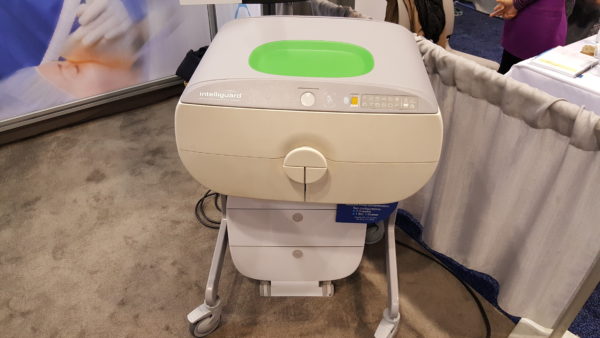
LVIS is a free-standing cart with three drawers – one large and two small. The cart looks quite different from any of the current anesthesia carts on the market. Take a look at the image below taken at the ANESTHESIOLOGY 2016 conference for a better understanding of what I’m talking about.
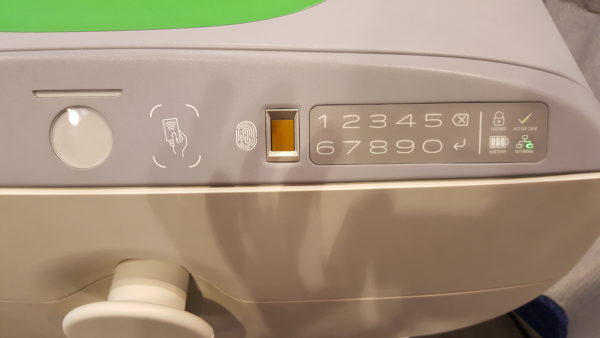
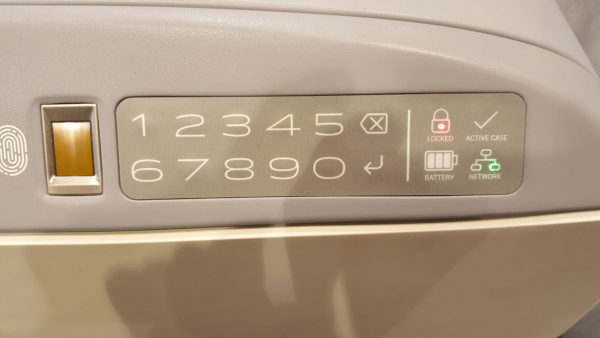
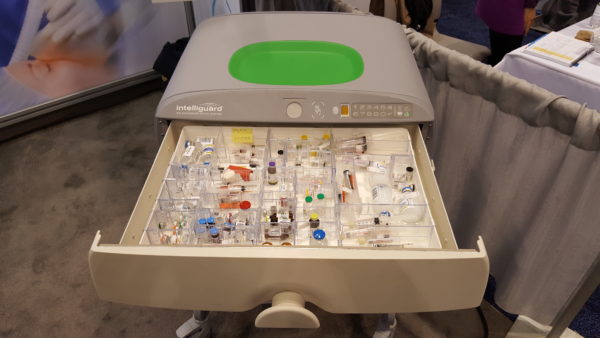
LVIS utilizes RFID technology to track medications in real-time. Items placed inside the cart are labeled with RFID tags – attached by the pharmacy or pre-tagged from some third parties like PharMEDium – and placed in a drawer. Once the cart is unlocked via one or a combination of locks – RIFD reader, biometric scanner, keypad for PIN (see image below) – the user has access to any medication in any of the drawers. Each time a drawer is closed, the system scans the contents and captures data on every medication, including item, quantity, user identification and time stamp. That’s it. If you take something out, the system knows. If you place something back in the drawer, the systems knows. The user is not required to debit or credit any item or scan the drug on removal or return. That’s a win for anesthesia providers and for the pharmacy. The provider gets access to medications without interring with their workflow, and the pharmacy gets real-time inventory numbers and complete transparency for what’s being used.
I like how the system was designed. There are several little things that show how much thought went into the product. For example, offering three different methods to log into the cart, or giving users the ability to configure access to each drawer individually, or offering an “in process” area to track items that have been removed but not documented as used (little green area on top of the machine), and so on. I also like how the system was designed with minimal impact on workflow in mind. Because LVIS uses RFID technology, most of what’s happening is transparent to the user, i.e. their workflow remains intact.
Not all is perfect, however. I’m not completely sold on the physical design of the system. I would like to speak to others that have seen the unit to get their feedback. The other questions I have are around integration with existing systems, especially EHRs and AIMS. That’s the elephant in the room with every small company trying to play with the big boys. Only time will tell, but I am encouraged by LVIS. I like the technology and I’m impressed with the thought that went into the product’s design.
I’m looking forward to learning more at ASHP Midyear in Las Vegas.
This is actually Episode 13. My apologies, but the volume is very low for some reason.
A brief discussion of Jerry’s presentation at Health Connect Partners (HCP) in Chicago on October 18, 2016, followed by a brief overview of some of the products he saw while at the conference.
In this episode, Jerry talks Radio Frequency Identification (RFID) technology with Shariq Hussain, President and CEO and Jay Williams, VP of Business Development at MEPS Real-Time, Inc. MEPS Real-Time, Inc. is a market leader in RFID technologies in pharmacy.
Jerry, Shariq, and Jay discuss RFID technologies, patient safety, and the companies two main products: Intelliguard Kit and Tray Management System for managing and tracking medication trays, code trays, intubation kits, etc., and the Intelliguard Vendor Management Inventory System, which consists of RFID technologies coupled with temperature controlled storage cabinets like refrigerators.
MEPS Real-Time, Inc. contact information: MEPS Real-Time, Inc.
6451 El Camino Real, Suite C
Carlsbad, CA 92009
Phone: 760.448.9500
Email: sales@mepsrealtime.com
NFC World: “The two companies [Thinfilm and Jones Packaging] are collaborating to integrate Thinfilm’s NFC OpenSense technology into paperboard pharma packaging and establish key manufacturing processes for production on Jones’ high speed lines.†In addition “the work…will also include the integration of ferrite shield labels with the NFC OpenSense tags. This will enable NFC to function on metalized packaging such as blisters …â€
Pretty cool stuff. By using NFC in the packaging, the simple tap of an NFC-enabled phone will allow you to authenticate the product, as well as track individual items. Would be neat to tie this into IV labels somehow.
This year’s ASHP Midyear Clinical Meeting was held at the Ernest N. Morial Convention Center in New Orleans, Louisiana on December 6 through December 10, 2015. For many, the Midyear Meeting is about the latest in clinical advances, but for me, it’s an opportunity to see all the new pharmacy automation and technology. And the best place to see the latest and greatest technology is in the exhibit hall.
Below you will find my thoughts on what I saw while roaming the exhibit hall. By no means is this an exhaustive list, but rather items that I think are worth mentioning and thinking about.
PHARMACY CLEAN ROOM
“Sterile compounding is a significant but perilous core pharmacy process in dire need of improvement.†– ISMP Jan 2015
The pharmacy clean room (a.k.a. iv room) continues to get a lot of attention, and rightly so. With the introduction of USP Chapter <800> and proposed changes to USP Chapter <797>, the clean room is on everyone’s mind. This year’s exhibit hall was a direct reflection of this.
The clean room automation and technology space is It was bound to happen. Over the past few years, several vendors have introduced products designed to help pharmacists with compounding sterile products or meeting clean room regulatory requirements.
Aesynt is now part of Omnicell and CareFusion is part of BD. BD has had more time to ramp up their messaging and it was obvious in their exhibit this year.
The Plus Delta Technologies booth was empty. Plus Delta’s products include PD, a medication tracking system, and IVTtrac, a semi-automated iv workflow management system. It is unclear whether the company has been sold, has gone belly up, or is simply keeping a low profile
APOTECA was not present in the Midyear Exhibit Hall this year. If you recall, APOTECA is the company responsible for APOTECAchemo, a robot for compounding hazardous drugs. Last year about this time they introduced APOTECAps, a semi-automated iv workflow management system. The company was conspicuously absent.
There was a good number of booths offering clean room consulting. More than I’ve seen in past years.
Aesynt – previously McKesson Automation, now part of Omnicell – was focused on data analytics in the clean room with two new products: REINVENT and Formulary Tool Kit (FTK). I wrote about REINVENT after the ASHP Summer Meeting in Denver. FTK is a tool designed to help pharmacies extend BUD in the cleanroom.
BD and Baxter seem to be running parallel races. Baxter had a press release at the meeting that focused on DoseEdgeBD did the same for Cato. Baxter will be pushing their Epic integration in the coming year.
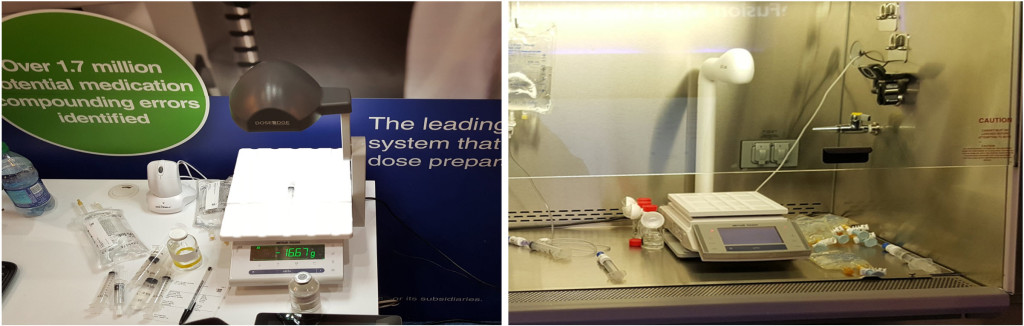
Baxter was showing off their DoseEdge scales for the first time ever at a Midyear event. DoseEdge has had gravimetric functionality for quite some time, but the concept has never been popular with their customers. Apparently that has all changed. Based on conversations with insiders, this appears to be a direct result of pressure from BD’s gravimetric-centric approach.
Imaging platform and scales from DoseEdge (left) and BD Cato (right)
MedKeeper showed off a new booth at Midyear with Verification front and center. Verification is MedKeeper’s semi-automated iv workflow management system. Something that caught my eye while I was in the MedKeeper booth was the images captured by Verification. They’re really quite good. I was especially surprised to find that some of the images I was looking at were taken from outside an isolator. That’s right, the device was mounted outside the isolator, thus limiting the hardware in the hood.
Verification by MedKeeper – images shown on screen taken from outside an isolator
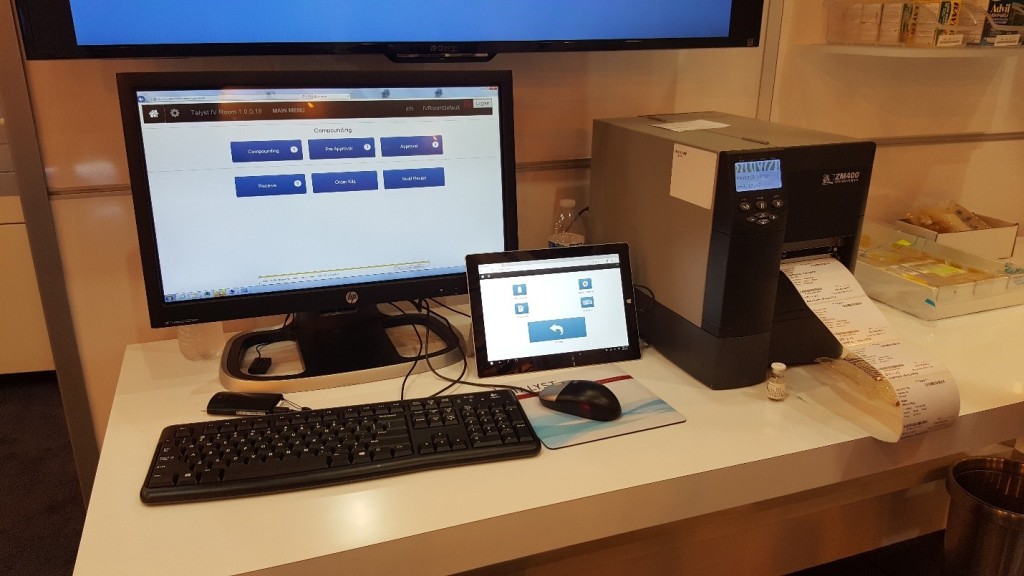
Talyst had Talyst IV Room on display. Talyst IV Room is part of the company’s mobile inventory management solution and offers users the ability to build IV kits utilizing barcode scanning for verification, as well as the ability to track sterile preparations throughout the compounding process.
Talyst IV Room product on display
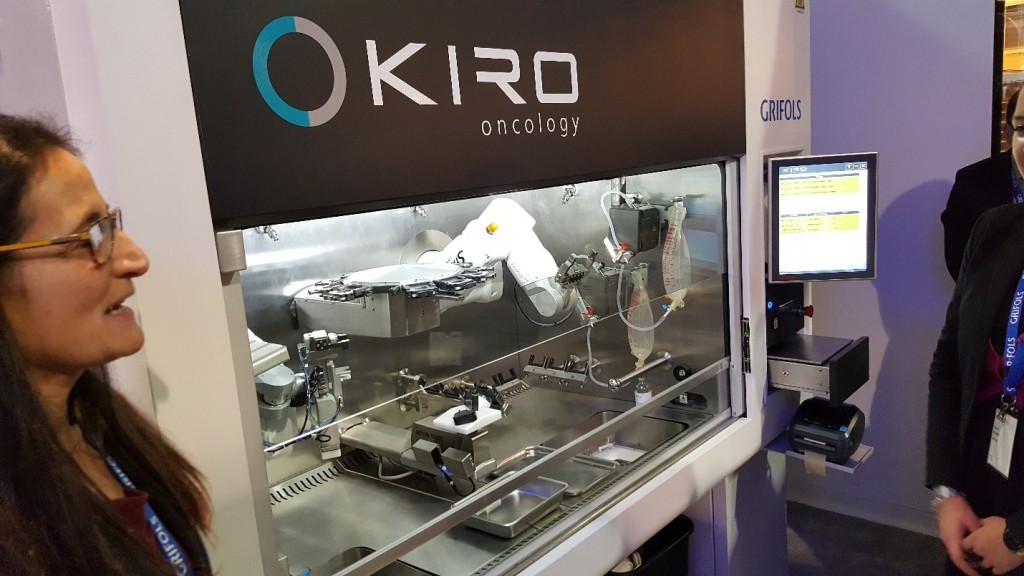
Grifols introduced a new hazardous drug compounding hybrid robot, Kiro Oncology. Kiro is a bit different from previous robots as it uses two robotic arms to compound sterile preparations. It’s an interesting concept.
Kiro Oncology robot from Grifols
Compounding robots were out in full force: Aesynt with v.STATION, ARxIUM with RIVA, and Grifols with Kiro Oncology.
RFID-ENABLED TECHNOLOGY
RFID-enabled technology was more prevalent at this year’s ASHP Midyear than I can recall in previous years. Booths that had RFID-enabled products on display were typically busy, and the people in those booths were engaged in conversation.
Does this mean that pharmacy has finally turned the corner on RFID? Perhaps, but the technology still has some barriers, both real and perceived to overcome. It is clear to me, however, that RFID has niches in pharmacy and vendors are finding those niches.
Three booths that I thought were particularly busy were MEPS Real-Time, Inc., Kit Check and FFF Enterprises.
MEPS Real-Time, Inc. was showing off their Intelliguard RFID system, which includes an RFID-enabled medication tray management system, controlled temperature cabinets (CTCs) – both refrigerated and room temperature – and a virtual logbook for tracking medication trays.
Kit Check had their “Little Blue Box†scanning station in the booth, which is part of their RFID-enabled medication tray management system. In addition, Kit Check was showing off their RFID-enabled Anesthesia Check system, which I thought was pretty cool. The design is well thought out and offers some nice functionality.
FFF Enterprises is a distributor of plasma products, vaccines, biopharmaceuticals, and biosimilars. Part of their product line includes Verified Inventory Program-Consignment (VIPc), which includes RFID-enabled refrigerators that offer automatic track and replenishment for their product line. Cardinal Health does something similar.
SencorpWhite was on hand with a small booth providing information on their RFID capable carousels. They didn’t have a physical carousel in the booth as in previous years, but instead opted for literature and a looping video to support their product offering.
PharMEDium announced that they will be making pre-filled syringes with RFID tags embedded in the labels. This is big, but the announcement went unnoticed by many. I wouldn’t have known about the move had I not been speaking to one of the vendors mentioned above. I verified this with one of the PharMEDium executives and was informed that the RFID-enabled pre-filled syringes will not be proprietary to any single company, and will be made available to anyone looking for pre-filled syringes with embedded RFID tags.
COLD CHAIN TECHNOLOGY
It has been clear for quite some time that refrigeration is going to be important for the next generation of pharmaceuticals, including biologicals. Pharmacies will need to invest in and utilize better security, as well as real-time monitoring for temperature, humidity, and inventory.
The exhibit hall was full of vendors offering real-time monitoring. Have a data connection, i.e. “the internet� If so, then you have everything you need to use many of these systems. Vendors are offering cloud-based storage of information, which means anytime, anywhere access to data. Real-time monitoring and alerts mean that pharmacy directors will have peace of mind that their pricey inventory is in date, properly stored, and in stock. It’s a win-win.
All the major pharmaceutical grade refrigerator vendors had a presence in the exhibit hall: Helmer, Follett, Migali Scientific. Not to mention seeing many other vendors with one of these brands in their booth. Partnerships and alliances appear to be the most efficient method of ensuring that you can offer a refrigerated solution to your customers.
Some items that I felt were particularly interesting in the cold chain area:
RFID-enabled refrigerators. See the section on RFID for more detail.
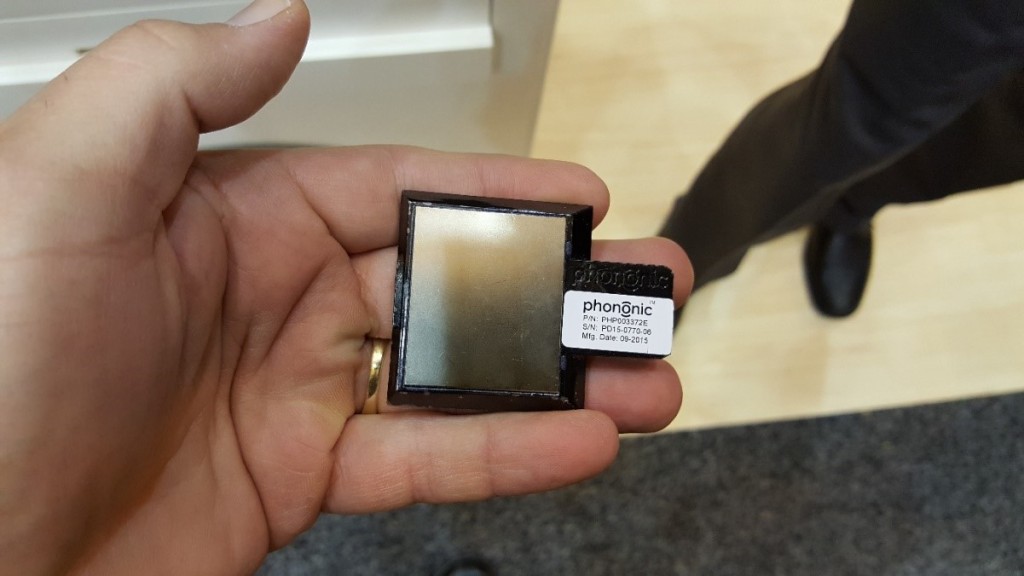
The Evolve line of pharmacy-grade refrigerators from Phononic were quite impressive. These refrigerators are powered by SilverCoreâ„¢ Technology. They have no compressor, meaning they have no mechanical parts, run quiet, use less electricity, and generate less heat. The refrigerators use solid-state heat pump technology coupled with a non-hazardous, non-toxic refrigerant. In addition, the units provide alerts for temperature, door, battery, memory, loss of Wi-Fi, and loss of power. Check the image below showing the solid-state “pumpâ€.
Phononic compressor-free refrigeration technology
Vaccine Smart-Fridge. I wrote about this back in September. The Smart-Fridge is an interesting concept. The system offers single-point access to vaccines, providing real-time alerts on inventory shortages and temperature. Automated temperature monitoring ensures that things stay within their appropriate temperature range, and analytics and historical dispensing data are collected and made available to the user.
STRIP PACKAGING FOR AMBULATORY CARE
Strip packagers have been around for a long time. They were popular in acute care for a while, but not so much anymore. However, there appears to be renewed interest in the technology for use in ambulatory care pharmacy, especially as a method of improving medication adherence. I spoke to several strip packaging vendors that are seeing renewed interest in the technology. Most attribute this to the introduction of strip packaging as a medication adherence platform made popular by recent coverage of PillPack.
DYNALABS DVxâ„¢ Onsite Drug Verification System. DVx allows users to quickly and easily verify drug identity and strength (concentration) in real-time. The demo was impressive. The representative that I spoke with said that DYNALABS currently had a limited reference library, but were adding new drugs all the time.
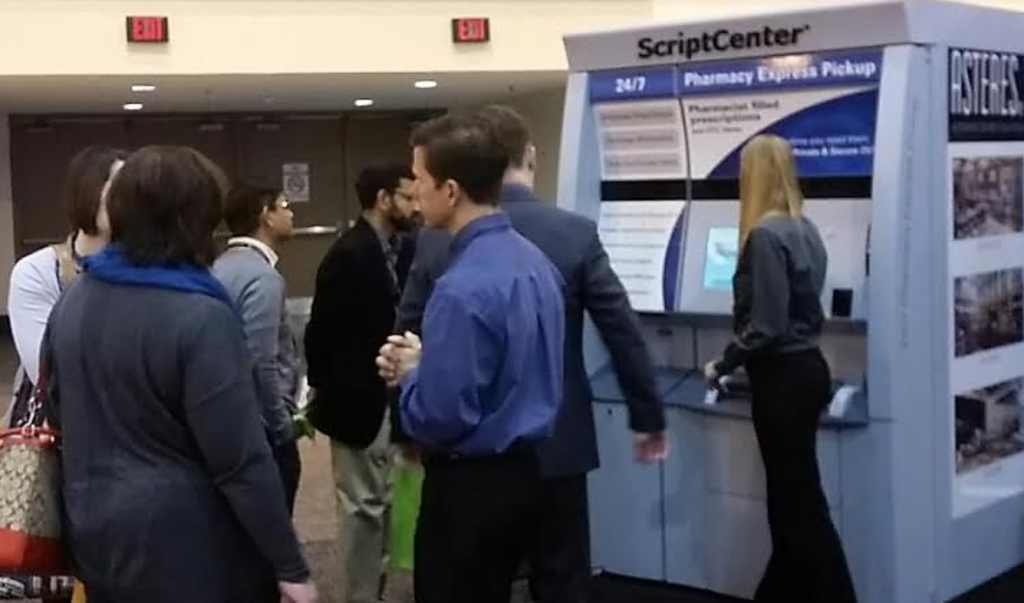
ScriptCenter by Asteres. Think of ScriptCenter as something similar to the Amazon Locker model. Pharmacies fill medications, place them in the ScriptCenter kiosk, and allow users to pick them up at their convenience. Kind of an ATM-style solution to medication refill pickup. The system sends messages to patients when their prescription is loaded and ready. Users can pay with credit card or payroll deduction. You can even load OTCs into ScriptCenter. I spoke to Dana Darger, Director of Pharmacy at Regional Health in Rapid City, SD about ScriptCenter. He has been using the unit to provide employees with 24/7 access to medication refills. So far he’s been pretty happy with the results. Dana commented that ScriptCenter has helped alleviate congestion in the outpatient pharmacy as well as give hospital employees easy access to their refills.
ScriptCenter by Asteres
Cactus Smart Sink. I wrote about the Cactus Smart Sink while attending Midyear. The Smart Sink is a pharmaceutical waste disposal container that renders its contents “unrecoverable, non-retrievable and unusableâ€. It’s small and unassuming. I thought it was pretty slick.
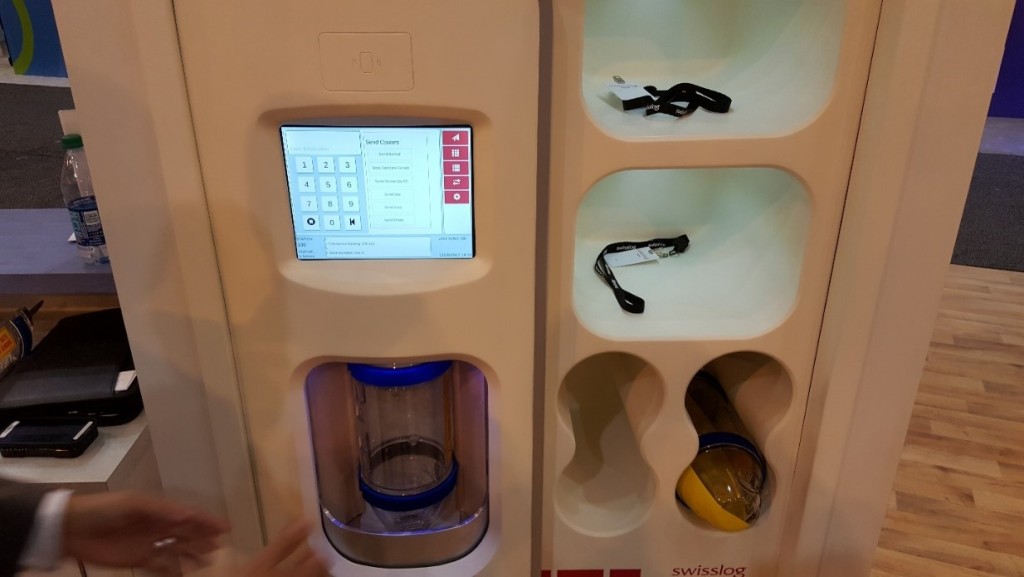
Swisslog Nexus Station. One has to wonder how a tube station can be exciting. Well, if you’ve ever worked in a pharmacy where items are queued up due to volume, then you’ll appreciate the Swisslog Nexus Station. The Nexus allows users to load up to five tubes at a time in a Lazy Susan-like configuration. Tubes can be loaded as non-secure or secure and the Nexus will keep track. Much more efficient than a “one-up†tube station.
Nexus Station by Swisslog
A PDF version of this report may be downloaded here.
Jerry talks about the use of RFID technology in pharmacies, specifically the use of RFID in refrigerated consignment programs and medication tray management.
I receive press release emails for several companies. One of those companies is Kit Check. I’ve written about Kit Check several times before.
Yesterday I received and email from Kit Check stating that “the U.S. Patent and Trademark Office has issued two meaningful patents with two more expected on June 16, 2015. The patented innovations reach back to Kit Check’s founding and are fundamental to automating key hospital pharmacy processesâ€. Ok, that caught my attention. I’m always curious when patents are granted.
The two patents issued are U.S. Patent Numbers 8,990,099 and 9,037,479. Both have to do with the management of pharmacy kits. I proceeded to the USPTO where I found the same abstract for both:
“A system for managing pharmacy kits comprises a reading station configured to read tag information from a plurality of radio frequency identification (RFID) tags associated with a pharmacy kit, and an information processing system operatively connected to the reading station and configured to receive the tag information from the reading station and determine a status of the pharmacy kit based on the tag information, a plurality of stored templates defining contents to be included in each of a plurality of pharmacy kits, and a plurality of kit records indicating the current contents of a plurality of pharmacy kits.â€
I didn’t spend any great amount of time reading through the details of the patents because let’s face it, people who write patents do a masterful job of filling space with useless dribble. Seriously, patents make pouring a cup of coffee sound like someone has created a method for generating perpetual motion. With that said, I did do a cursory overview.
I was surprised at the gist of what was patented. In summary, the patents were given for a system that uses RFID tags to read things inside a closed container. Obviously there’s a bit more to it than that, but that’s my understanding of the patents in a nutshell.
I cringe when I see patents like this because it’s proof that you can patent just about anything these day. And in my opinion it stifles innovation, creativity, and ingenuity.
Does this mean that other companies won’t be able to develop a closed system that reads multiple items with RFID tags? I certainly hope not. Only time will tell what Kit Check plans to do with these patents, but I can only guess that they didn’t spend all that time, energy, and money for the heck of it.



 I receive press release emails for several companies. One of those companies is