InformationWeek Healthcare: “The rollout is believed to be the nation’s largest EMR deployment to date, said North Shore LIJ CIO John Bosco. The health system serves five million people in the New York metro area, operating 14 hospitals, 18 long-term care facilities, five home-health agencies, dozens of outpatient centers, and a hospice network. Under the North Shore LIJ Electronic Health Record initiative, 1,200 staff physicians and 5,800 affiliated physicians will be offered subsidized EMR systems. EMR software will be provided by Allscripts and hosted using a cloud-based model by an unnamed Allscripts partner, Bosco said.” – The article goes on to say that North Shore LIJ will subsidize approximately 85% of the cost and allow physicians to keep any reimbursement earned under the ARRA. I’d say that is a pretty smart move on the part of LIJ. After all, getting physicians to use new technology is a difficult process. With this offer LIJ will get EMR use entrenched in the minds of approximately 7000 physicians in the New York area. It will be very interesting to see how things go over the next 5 years.
Month: October 2009
-
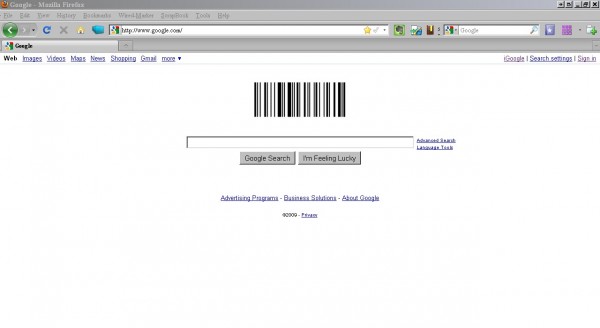
Google showing a little bar code love this morning
My browser homepage is set to Google. Imagine my surprise this morning when I saw the Google homepage was sporting a bar code in place of the typical “Google”. Cool!
-
Thoughts on creating a BCMA cross reference file
 Our facility is gearing up to implement bar code medication administration (BCMA) in February 2010. Part of getting ready is making sure that all the medications dispensed from the pharmacy are bar code ready. If the medication isn’t bar coded or won’t scan, then it won’t do the nurse much good at the bedside. We’re in pretty good shape secondary to our carousel install in February of 2008. Everything that gets stored in the carousel is already bar coded. I had hoped that the file stored in our AutoPharm, i.e. carousel, cross reference file could simply be dropped into our Siemens Pharmacy cross reference file, but that would have been too easy. Siemens refused to play nicely with the data.
(more…) -
“What’d I miss?” – Week of September 27th
As usual there were a lot of things that happened during the week, and not all of it was pharmacy or technology related. Here’s a quick look at some of the stuff I found interesting.
(more…) -
Getting pharmacists to lay down their 3×5 cards
The decentralized pharmacy model brings with it the opportunity for pharmacists to be an integral part of the medical team. This includes following teams of healthcare provides, physicians, nurses, respiratory therapists, etc, on morning rounds. And like all good little pharmacists we like to be prepared with as much information as possible about the patient. Several methods for collecting data have been developed over the years, including the all time favorite; the 3×5 index card. The problem with this system is obvious; it’s prone to human error. Taking information from one source and transcribing it somewhere else simply increases the chance for error. In addition, the information may be inaccurate as things can change rapidly with hospitalized patients, especially in areas like the ICU.
(more…)
