Medical Smartphones: “We all know that the AT&T network is having difficulty keeping up with the data load caused by a multitude of iPhone users. What will happen when the iPad becomes available? Will the networks get more congested? Will AT&T have the necessary infrastructure to provide adequate 3G services for all these new iPads that will be floating around?” – Joseph goes on to ponder how long it will take Versizon to get the iPhone as his wife is eagerly waiting for it. I too have been waiting for the iPhone to drop into Verizon hands. Even though I’m satisfied with my Droid, I will convert to the iPhone once available through my carrier. Unless, of course, something better comes along in the meantime. The reason why I would switch is simple; the iPhone is so widely used among healthcare professionals that application development for the device is on the forefront of technology. If you can’t find it for the iPhone, then it probably doesn’t exist.
So, what will happen when the iPad hits AT&T? I have no idea because I don’t plan to buy one with 3G. I will use the device like I use my iPod touch now; inside the walls of my house, the hospital and Starbucks.
To continue with the radiology theme from yesterday: Toomey RJ, Ryan JT, McEntee MF, et al. Diagnostic Efficacy of Handheld Devices for Emergency Radiologic Consultation. Am. J. Roentgenol. 2010;194(2):469-474.
Abstract: Diagnostic Efficacy of Handheld Devices for Emergency Radiologic Consultation
OBJECTIVE. Orthopedic injury and intracranial hemorrhage are commonly encountered in emergency radiology, and accurate and timely diagnosis is important. The purpose of this study was to determine whether the diagnostic accuracy of handheld computing devices is comparable to that of monitors that might be used in emergency teleconsultation.
SUBJECTS AND METHODS. Two handheld devices, a Dell Axim personal digital assistant (PDA) and an Apple iPod Touch device, were studied. The diagnostic efficacy of each device was tested against that of secondary-class monitors (primary class being clinical workstation display) for each of two image types—posteroanterior wrist radiographs and slices from CT of the brain—yielding four separate observer performance studies. Participants read a bank of 30 wrist or brain images searching for a specific abnormality (distal radial fracture, fresh intracranial bleed) and rated their confidence in their decisions. A total of 168 readings by examining radiologists of the American Board of Radiology were gathered, and the results were subjected to receiver operating characteristics analysis.
RESULTS. In the PDA brain CT study, the scores of PDA readings were significantly higher than those of monitor readings for all observers (p 0.01) and for radiologists who were not neuroradiology specialists (p 0.05). No statistically significant differences between handheld device and monitor findings were found for the PDA wrist images or in the iPod Touch device studies, although some comparisons approached significance.
CONCLUSION. Handheld devices show promise in the field of emergency teleconsultation for detection of basic orthopedic injuries and intracranial hemorrhage. Further investigation is warranted.
I’m not as sharp as many of you so I had to actually look up the word roentenology, which means “Radiology, the science of radiation and, specifically, the use of both ionizing (like X-ray) and nonionizing (like ultrasound) modalities for the diagnosis and treatment of disease.”
According to the article “the scores of PDA readings were significantly higher than those of monitor readings when all observers’ readings are taken into account” and “no statistically significant differences between handheld device and monitor findings were found for the PDA wrist images or in the iPod Touch devices studies, although some comparisons did approach significance.”
An interesting follow-up to this study would be to insert an iPad into the same scenario against the iPod touch. I would be very interested to see how radiologists would react to that. The iPad would offer similar functionality to the iPod touch with the advantage of a larger screen. I can only speculate that more screen real estate would be preferred over less screen real estate for radiologists if given a choice. Just a thought.
medgadget: “eMedia Interactive Ltd. out of Galway, Ireland has released an iPhone app to help learn the anatomy of the heart. Using the Pocket Heart app, one can browse the organ in three dimensions using zoom and rotate features, identify individual components, and take quizzes to test one’s knowledge. This simulator might also be helpful to medical students, residents and clinicians learning to perform echocardiography, by allowing to correlate echo images to the anatomy. So grab the Pocket Heart and head to our own EchoJournal to learn more about cardiac echoes.” – Pocket Heart is a nifty little application. Go check out the website and run through the demo.
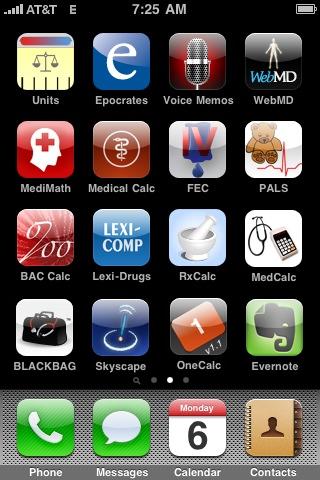
The iPhone and iPod Touch have created quite a wave in healthcare, and along with the wave has come a plethora of healthcare applications. The user interface on the iPhone/iPod Touch combined with the ease of accessing applications on Apple’s iTunes store and the relatively inexpensive nature of most applications, have made these devices a favorite among healthcare professionals.
With the volume of healthcare related applications available, I’m surprised at how few I actually use. I spend quite a bit of time surfing the app store looking for new applications that I can apply to pharmacy. I’ve downloaded numerous applications, but have deleted most for one reason or another.
My “research” has led to the list below of applications that I find most useful as a pharmacist.
Read more…
Healthcare IT Consultant Blog: “It appears Caretools has thought of this, offering its iChart EHR for the iPhone, immediately available to anyone on the iTunes store. Before you scoff that it must be a limited-functionality, toy of an EHR, consider this: it offers ePrescribing, transmission of lab reports, ICD9-compliant billing code functionality, and a sophisticated menu system to quickly create SOAP and Procedure notes. It might not be CCHIT-certified (yet) or guarantee your eligibility for “meaningful use” funding, but at such a low price point, it could be a great way to get your physicians comfortable with standard EHR functionality.” – I took a quick jaunt over to the Caretools website and gave the application the once over. I think it’s pretty cool. At a mere $139.99 it’s about the cheapest EMR system you’re going to find on the market. You can read more about it at the iPhone Life website. Next thing you know, you’ll even be able to make phone calls directly from your iPhone.
Healthcare IT Consultant: “Buoyed by the encouraging use of its PHR and Twitter based Clinical Trial matching service, TrialX is readying to release its iPhone application this month. This application, designed for doctors and patients, further underscores TrialX’s commitment to drive technology enabled consumer-driven healthcare. Using the TrialX iPhone App, doctors can search for clinical trials that their patients may be eligible for and email the results to the patients right away. They can filter clinical trials by location, medical condition, treatment, institution conducting the trial and other parameters. Similarly, patients and/or their loved ones can use this application to search for clinical trials. A video demo and screenshots of the new application are available at TrialX Mobile (http://trialx.com/mobile).” - You can search for clinical trials at the TrialX website as well. In addition, TrialX can identify clinical trials that may fit your condition based on your Google Health or MicrosoftVault profile. Take a second to browse around their site, it’s pretty slick.
I have a couple of passions when it comes to pharmacy. The first is a love of pharmacy technology. Very few pharmacists have an appreciation for the “operations” side of pharmacy which includes automated dispensing cabinets, automated carousels, automated TPN compounders, Pharmacy Information System, etc. These tools are absolutely necessary if we want to get pharmacists out of the physical pharmacy and at the bedside where they belong. My second passion is a little less known discipline known as pharmacokinetics. I have no idea why I like pharmacokinetics; I just do. Some kids like PB&J and some don’t. It’s just the way it is.
Read more…
mobilehealthnews: “For the record, BlackBerry has conducted clinical trials with smartphones paired with Bluetooth-enabled medical peripheral devices for years. Three of the company’s smartphones are among the five most popular smartphones in North America. At least one executive at BlackBerry-maker Research In Motion is a bit curious about all the hype around Apple’s recent medical foray with the iPhone. mobihealthnews recently had the chance to discuss wireless healthcare trends with Research In Motion’s Fraser Edward who heads the company’s Healthcare Marketing Group. In this second installment, Edward explains the points above and much, much more, including: which types of BlackBerrys physicians prefer, why wireless health needs to adopt a “belts and braces” approach, how RIM’s latest acquisition — Chalk Media — fits into wireless health, and what the BlackBerry App World’s advent signifies. Edward also shares his favorite App World app.” – Edwards goes on to talk about physician preferences for various BlackBerry devices, going as far as to say “to pinpoint the phones that I’ve seen us getting a lot of traction on within the medical community — it would be the Storm and the Bold“. If I were to use a BlackBerry device, I believe it would be the Storm. I like the idea of a touch screen more and more each day. However, I’ve heard many people claim the Bold is much better for messaging. The future of BlackBerry devices appears fuzzy as the iPhone’s popularity continues to grow. It seems that every physician, pharmacist and IT professional I see in the hospital is carrying an iPhone. Remember the days of the Palm Pilot and its incredible popularity? There was a time when Palm powered handheld devices enjoyed the same popularity as the BlackBerry devices do today. As the smart phone revolution got underway, Palm devices simply disappeared. The popularity of the iPhone will eventually do the same to the BlackBerry, especially when Apple begins offering the iPhone through other carriers. Among pharmacists in “my circle”, I am one of the few that chose not to change carriers for the iPhone. Only time will tell what will happen to BlackBerry smart phones, but I see the end sooner than later unless Research In Motion has something up its sleeve. Apple and the iPhone are simply too powerful. Good luck BlackBerry, you’re going to need it.
Apple Core Labs Blog: “Apple Core Labs first iPhone/iPod Touch application, RxCalc, is now available on the iPhone App Store.”
RxCalc is an idea that my brother and I have had for quite some time. The idea for a portable pharmacokinetics calculator originated many years ago during my infatuation with the TRGpro and the Palm Operating System. The timing for the application was never quite right, but the appearance of the iPhone changed all that. The portability, advanced features and popularity of the iPhone make it the ideal platform for developing a portable pharmacokinetics calculator.
RxCalc was designed as a tool for pharmacists to perform aminoglycoside and vancomycin kinetics, including new starts using population parameters and dosage adjustments using levels.
The code and user interface was written and developed by Apple Core Labs (Robert Fahrni), while I was responsible for the math and user experience (i.e. the workflow).
Apple Core Labs would like to recruit some pharmacists to use the application and provide feedback, good or bad. To receive a free promotional code redeemable at the iTunes store stop by the Apple Core Labs Blog and simply follow the instructions.


AppleInsider.com: “The University of Florida is the second school in as many months to announce that students enrolling in one of its curriculums this fall will be required to own either an iPhone or iPod touch, highlighting an increasing role for Apple’s multi-touch devices in higher education.” -When I graduated from pharmacy school in 1997, a laptop was considered really big news. I wonder where we’ll be in another ten years. Who knows, but I’m looking forward to it.