The 2012 unSUMMIT will be held on May 2-4, 2012 at the Hyatt Regency Orange County in Anaheim, California. Heck, that’s right in my backyard. Looks like I’ll be attending.
mobihealthnews: “Socket Mobile announced this week the availability of its latest Socket Bluetooth Cordless Hand Scanner (CHS) Series 7, a barcode scanner with medical applications which has been Apple-certified as a “Made for iPad, iPhone, iPod” accessory.
“This is the best performing barcode scanner for developers who are creating applications incorporating barcode scanning for the Apple iOS,” stated Samantha Chu, data collection product manager at Socket Mobile, in a press release. “There are numerous applications that stand to benefit from barcode scanning in a range of vertical markets, and we believe the CHS 7Xi provides the Apple developer community with a level of control and data integrity that didn’t exist previously.”
I’ve mentioned the CHS Series 7 scanners before. They really are neat little devices; small, quick and accurate.
Another scanner worth mentioning in this category is the Koamtac KDC200. I’ve used the KDC200 and it’s a pretty slick scanner as well.
I’ve just spent four days at the ASHP Summer Meeting in Denver, CO. The meeting offered a nice variety of topics, but seemed to focus on medication safety and informatics more this year than in the past. In fact, this is the first year that ASHP has offered a medication safety tract at one of their meetings.
I avoided the more traditional sessions on therapeutics, choosing instead to focus on the informatics and medication safety sessions. Based on the information presented it was obvious to me that these two disciplines are intimately linked. After all, the idea behind much of the technology we use in healthcare today is to improve patient safety.
Continue reading »
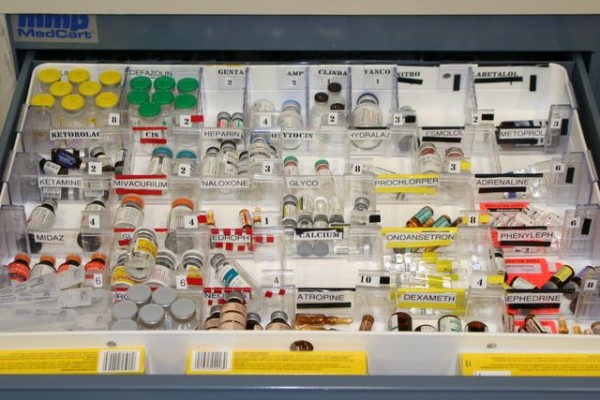
Labeling syringes has always been difficult for anesthesiologists in the OR. It must be because they never seem to get it right. If you don’t believe me, just look at the image below. These drugs were found during routine inspection of an OR suite. Well that’s all changed now with the Codonics SLS Safe Label System.
Continue reading »
There’s an interesting article in the February 2011 issue of The Annals of Pharmacotherapy dealing with BCMA and what the author describes as “clinical workarounds”.1
Abstract
BACKGROUND: Bar code medication administration (BCMA) technology is gaining acceptance for its ability to prevent medication administration errors. However, studies suggest that improper use of BCMA technology can yield unsatisfactory error prevention and introduction of new potential medication errors.
OBJECTIVE: To evaluate the incidence of high-alert medication BCMA triggers and alert types and discuss the type of nursing and pharmacy workarounds occurring with the use of BCMA technology and the electronic medication administration record (eMAR).
METHODS: Medication scanning and override reports from January 1, 2008, through November 30, 2008, for all adult medical/surgical units were retrospectively evaluated for high-alert medication system triggers, alert types, and override reason documentation. An observational study of nursing workarounds on an adult medicine step-down unit was performed and an analysis of potential pharmacy workarounds affecting BCMA and the eMAR was also conducted.
RESULTS: Seventeen percent of scanned medications triggered an error alert of which 55% were for high-alert medications. Insulin aspart, NPH insulin, hydromorphone, potassium chloride, and morphine were the top 5 high-alert medications that generated alert messages. Clinician override reasons for alerts were documented in only 23% of administrations. Observational studies assessing for nursing workarounds revealed a median of 3 clinician workarounds per administration. Specific nursing workarounds included a failure to scan medications/patient armband and scanning the bar code once the dosage has been removed from the unit-dose packaging. Analysis of pharmacy order entry process workarounds revealed the potential for missed doses, duplicate doses, and doses being scheduled at the wrong time.
CONCLUSIONS: BCMA has the potential to prevent high-alert medication errors by alerting clinicians through alert messages. Nursing and pharmacy workarounds can limit the recognition of optimal safety outcomes and therefore workflow processes must be continually analyzed and restructured to yield the intended full benefits of BCMA technology.
The study described in the article utilized a combination of retrospective analysis and direct observation to identify alert triggers generated by a BCMA system. In addition the study looked at various workarounds utilized by nursing as well as pharmacy. The article is a much more limited version of the one by Koppel in 2008.2
The Annals article identifies some disturbing trends at the Medical University of South Carolina (MUSC) where the study took place. Examples include failure to document override reasons for 77% of alert messages and 468 directly observed workarounds during 121 administration attempts over a 6 hours period. Those number are a sure sign of a poorly designed system and lack of institutional oversight. It certainly has nothing to do with BCMA and the overall effectiveness of the technology. Sounds like some disciplinary action is in order.
One other thing I found unusual in the article was the classification of pharmacy workarounds. “Specific pharmacy workarounds included duplicate orders, lack of medication order verification, medications within the incorrect section of the eMAR (prn vs standard administration time), and incorrectly timed medications causing administration too late/early for the nursing staff.” I’m not sure how you see this, but a duplicate order isn’t a workaround, it’s an order entry error. Same goes for entering an order as PRN instead of SCH. Not sure what the author had in mind when he made the decision to classify these as workarounds. Weird.
- Daniel F Miller, Christopher R Fortier, and Kelli L Garrison Bar Code Medication Administration Technology: Characterization of High-Alert Medication Triggers and Clinician Workarounds Articles Ahead of Print published on 1 February 2011, DOI 10.1345/aph.1P262. Ann Pharmacother ;45:162-168.
- Koppel R, Wetterneck T, Telles JL, et al. Workarounds to barcode medication administration systems: their occurrences, causes, and threats to patient safety. J Am Med Inform Assoc 2008;15:408-23.
Some items in a pharmacy are simply difficult to bar-code. Perhaps they’re too small, have an awkward shape or their surface won’t accommodate ink or an adhesive. The problem creates some interesting workarounds, and not always for the better.
One solution is to individually package each item and place the drug information and a bar-code on the outside of the packaging material; overwrapping, if you will. I’ve never been a big fan of overwrapping items because it can be time consuming and cumbersome. Today I ran across a machine that I think offers a genuine option for medications that are difficult to bar-code.
Continue reading »
The National Drug Code, or NDC number as it’s affectionately called in pharmacy, is a set of numbers used to uniquely identify “human drugs and biologicals“. Every pharmacist is familiar with the NDC number, but if you’re not it’s basically a unique number assigned to each package of medication. It’s an 11 digit number in a 3-segment format, i.e. XXXXX-XXXX-XX.
The first segment consists of five digits and indicates the manufacturer of the drug. The second segment is four digits used to identify the medication and strength. And the final segment of two digits represents the package size.
Continue reading »
Recently I’ve heard of hospitals having problems with barcodes on pre-mixed IV bags. The problem isn’t related to the legibility or quality of the barcodes, but rather the location and/or the information contained within the barcode itself.
Continue reading »
A couple of weeks ago a friend and colleague shot me an email asking me if I’d heard about the new “pedigree stuff on barcoding”. I consider myself pretty well informed for the most part, but I had no idea what she was talking about. Upon further inquiry she sent me a PDF document titled “Guidance for Industry Standards for Securing the Drug Supply Chain – Standardized Numerical Identification for Prescription Drug Packages” (the SNI document). The document is also available in non-PDA format at the FDA website here. I asked other pharmacists about the SNI document while at the Siemens West Coast User Group Meeting on September 16, but no one had a clue what I was talking about; not event the Siemens product manager that was in attendance.
Continue reading »
One Nucleus: “The technique will allow faster identification and resolution of any manufacturing quality problems but will also prove invaluable as an anti-counterfeit measure because the specific coding and validation systems are almost impossible to copy.
Currently most components within diagnostic kits, medical devices and other healthcare products and equipment are ‘stamped’ with a lot code at the point of manufacture. However, these codes are of limited use for quality improvement unless products are produced in very small batches. As a result, regulatory bodies across the world are now putting manufacturers under increasing pressure to invest in much more sophisticated traceability systems, while manufacturers are looking for effective ways to prevent the growing problem of counterfeiting of pharmaceuticals and other healthcare products.
The breakthrough approaches being developed by Innomech will enable manufacturers to mark products with a code that is either unique to the item or shared by only a small number of items produced together.
The codemark is an unobtrusive two-dimensional dot matrix identifier that is linked to a look-up database. In effect the matrix code acts as a ‘key’ to access much more detailed information, such as the specific batch codes of raw materials used during production, the time of manufacture, the production line and so on. A version of the database could be accessible online for anyone to verify the item is genuine.
The codes can be printed or laser etched onto products, applied to virtually any substrate and can even be added onto the surface of pharmaceutical capsules or coated tablets. Matrix codes can be as small as 2 mm by 2 mm holding the code for up to 10 billion numbers. The codes can be read by widely available readers or in many cases from a picture taken with even the simplest camera phone, making them ideal in the battle against counterfeit medicines.”
This is an interesting approach to an age old problem. I wonder if this technology could be used to embed drug information directly on the medication as well, an idea that I hijacked from the Nursetopia website where Joni Watson muses that “Both companies and pharmacies could add a QR code/Microsoft Tag to the medication label for patients and/or healthcare professionals to scan and directly access the patient medication information sheet.” Why not put the QR code directly on the medication itself? Why not indeed.