Month: October 2009

  • Which internet browser do you prefer?

    I can’t help myself. I’m constantly tinkering with one thing or another when it comes to my laptop. Lately I’ve been playing around with different internet browsers. Like everyone else, I cut my teeth using Internet Explorer (IE); mainly because it was the only browser out there for a long time. Things have certainly changed as there are now several browsers to choose from and IE is no longer king.

    On occasion I will download the most recent version reincarnation of IE. I’m not sure why I do it, but I do. No matter what changes Microsoft makes the browsing experience just isn’t what it could be. IE improves with each release to be sure, but the improvements always seem to come up short.
    (more…)

  • The “cloud” gets a black eye

    InformationWeek: “Think of the one million T-Mobile Sidekick customers that may have lost important data last week. Think of the dozens of CIOs that anxiously waited for Workday to restore its SaaS service on Sept 24. Cloud computing has created a new era of accountability, and we must demand that tech vendors work harder than ever to prove their trustworthiness. In both of these instances, customers were completely dependent on their vendors to manage their data. And in both instances, technical failures are to blame. The growth of cloud computing is not going to let up—we’re not going to suddenly start moving away from the Internet and speedy networks and store more data on our home PCs and company servers—so it’s time that everyone, from consumers up to CIOs at the world’s biggest companies, start asking questions and demanding accountability from their vendors.” – Cloud computing has been taking a beating in the press lately. Everywhere I turn someone on the internet is talking about the Sidekick fiasco, and I have to agree that permanently losing your customers data is inexcusable. However, this type of failure happens in the “non-cloud” environment as well, you just don’t hear about it. Last year our facility had an email server fail. Some, but not all, data was lost and we were without email services for nearly two weeks. It was the most productive time of my life. The cloud model is relatively immature at this point in time and will suffer failures and setbacks as it continues to develop. Hopefully the Sidekick failure has provided us with a valuable lesson that will be used to further improve the cloud. Only time will tell.

  • Looking forward to clinical advancement with Windows 7

    HealthBlog: ““For example, as the use of tablet PCs within healthcare continues to grow, many of us will welcome the improved hand-writing recognition facility in Windows 7. It also learns, so the recognition gets better the more I use it.” He says the same is true for voice recognition: “I just talk to my PC and it does what I want, from opening programs to dictating letters.” The true party piece of Windows 7, though, is its support for touch – not just touchscreens but what has come to be called ‘gesturing’; support for a sophisticated but more naturalistic way of interacting with technology. “Clinicians are able to zoom in on an image by moving two fingers closer together, like they’re pinching something, or zoom out by moving two fingers apart,” says Dr Crounse. “They’ll even be able to move an image on the screen by rotating one finger around another, and right-click by holding one finger on their target while tapping the screen with another.” This sort of natural manipulation of text, images and multimedia will make computer equipment less obtrusive in the clinician-patient relationship; and should make technology accessible to many communities which use healthcare extensively, yet were previously somewhat overlooked by IT: for example the elderly.” – I’ve been a proponent of touch technology for quite a while and firmly believe that it will have a positive impact on healthcare professionals. We’ve already seen an explosion in the number of devices developed to take advantage of Windows 7 and multi-touch technology. I, for one, can’t wait to get my hands on a copy of Windows 7 to install on my tablet.

  • Using technology to advance pharmacy practice through education

    funny_tech_cartoonI found an interesting article in the October issue of the American Journal of Health-System Pharmacy. The article, titled Informatics in clinical instruction (Am J Health Syst Pharm. 2009 Oct 1;66(19):1694, 1699), gives a description of a software system designed by the authors that “allows students at one site to receive online and teleconference instruction from preceptors at multiple sites through remote, interactive discussion. It also allows “blogging” based on assigned videotapes, simulation modules, live patient cases, discussion questions, and primary literature review. In addition, the system facilitates clinical encounter documentation, including interviewing patients, taking physical assessments (e.g., blood pressure), taking medication histories, assessing for adverse effects (e.g., abnormal involuntary movements), and addressing potential or actual medication-related problems(MRPs).”
    (more…)

  • How to perform an autopsy without getting dirty.

    Norrköping Visualization Centre and the Center for Medical Image Science and Visualization in Sweden have developed a Virtual Autopsy Table. The table makes use of high resolution MRIs to create incredible 3D images that can be manipulated on the table via multi-touch technology.
    (more…)

  • What tablet PC information did I miss? [Week of October 4th]

    I’m constantly trolling the internet for information on tablet PCs. What can I say, I’m addicted. And believe me, there’s was no shortage of stuff to read this week. Reports of the death of the tablet PC have been greatly exaggerated. I was going to add these thoughts to the “What’d I miss” post from yesterday, but it was just too much information. Anyway, here’s some tablet PC stuff I found interesting this week.
    (more…)

  • “What’d I miss?” – Week of October 4th

    As usual there were a lot of things that happened during the week, and not all of it was pharmacy or technology related. Here’s a quick look at some of the stuff I found interesting. (more…)

  • Cool Technology for Pharmacy

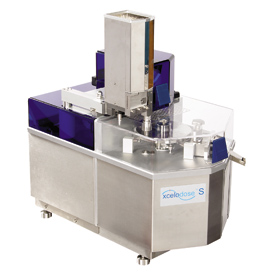
    xcelerdose600The Xcelodose 600 S System , manufactured by Capsugel, a division of Pfizer, is a precision powder micro-doser and automated encapsulator designed for pharmaceutical research and development. The system has the ability to fill formulations or active pharmaceutical ingredient (API) directly into capsules with a remarkable level of accuracy. The Xcelodose can weigh doses as low as 100 micrograms from a variety of powders, including free flowing, sticky, granular and blended. In addition, the Xcelodose can dispense API in capsule sizes ranging from 00 to 4.

    Simply poor the ingredients into the hopper, select the proper capsule size and hit the “go” button. Nothing could be simpler. The Xcelodose 600 can generate up to 600 capsules per hour while keeping detailed records of individual, as well as batch, capsule weight. Capsules not meeting strict control standards, typically 2% tolerance, are automatically jettisoned by the machine. By encapsulating API directly into capsules without the need for excipients, the Xcelodose System can reduce the amount of ingredient required and reduce overall development time by simplifying the process.

    The entire process is controlled via a computer terminal with a graphical user interface written in Visual Basic. While not designed for individual pharmacy use, it’s still one heck of a machine.

  • Using bar codes and a cell phone camera to avoid food allergies

    scanavert_beta

    ScanAvert is an application that uses the camera on your cell phone to read product bar codes and compare the ingredients to a personalized allergy list on the company website. The product was launched at the Health 2.0 conference in San Francisco this week and is apparently still in the beta phase.

    Consumers register for the service at our website, creating a profile from the allergy, prescription, dietary requirement/restriction, and illness categories. They may also establish limits on any of the nutritional values, e.g., carbohydrates, calories. In store aisles, customers scan product barcodes, with their auto focus camera phones, to receive instant feedback as to product compatibility/incompatibility and suggested compatible substitutes.

    Our technology will enable shoppers to determine that the products they are purchasing for themselves and their families are compatible with their allergic, prescription, or dietary profiles, e.g., void of peanuts, or, do not contain gluten, an ingredient considered harmful to an individual with Celiac Disease.

    The value proposition of ScanAvert is its simplicity and ease of use for the numerous and varied demographic populations that will reap its benefits. For the supermarket, restaurant chain, or food service vendor, it is a unique way to distinguish itself from competition and to provide a new and valuable service for a significant portion of their customer base.

    ScanAvert uses First DataBank, a well respected drug information source, to check for information on incompatibilities between prescription drugs and substances found in grocery products. This would be a great application for those with food related allergies.
  • Using a “micro shuttle” to control drug delivery

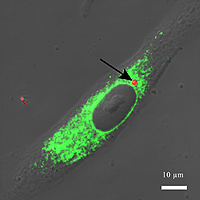
    microshuttle_in_cellQueen Mary University of London: “The capsules, which have a diameter of two micrometers (about the size of a bacterium), are built by wrapping strands of a metabolism-resistant material around spherical particles, which are then dissolved in acid, leaving behind an empty container. To fill the capsules, the scientists heat them in a solution that contains the desired drug compound. This makes them shrink and traps some of the solution and compound inside. The loaded capsules are introduced into live cells by a technique known as electroporation – a tiny electric shock – which makes the cell walls permeable for micrometer-sized particles. The cells are unharmed by this treatment and retain the capsules.” – The article refers to the capsules as “micro shuttles” and states that the release of medication could also be controlled “by a biological trigger like a drop in blood sugar levels, or activated manually with a pulse of light.” – I worked on something similar as an undergrad. We applied various currents to polyaniline, forcing the polymer to take up and hold certain molecules. Reversing the current resulted in the polyaniline dropping the substance. Crazy technology! It makes me want to get into R&D.