EMR Daily News: “Recording and charting changes in vital signs has been identified as one of the core areas that will be measured for meaningful use incentives. The new Intelligent Medical Devices HIMSS Analytics white paper, sponsored by Lantronix (NASDAQ: LTRX), and posted on the HIMSS Analytics website, details progress on these efforts. The research suggests that just one-third of hospitals in the HIMSS Analytics sample on medical device utilization indicated they had an active interface between medical devices at their organization and their electronic medical record (EMR).”
(more…)
Category: EMR
-
Integration of medical device data into EMRs
-
EMR data exchange with web services (article)
I came across an interesting article recently in the International Journal of Biomedical Engineering and Technology1. The article discusses the difficulties in designing an EMR system capable of providing optimal access to data elements while remaining efficient and user friendly. Â It was a good look at the current state of healthcare data exchange.
Abstract:
This paper discusses how to share medical information between heterogeneous applications via web services. Our design theory is based on a real-options framework, performance analysis and experience building iRevive, a working web-services-enabled pre-hospital documentation application. The trade-offs between efficiency and flexibility are examined in the context of exchanging information based on emerging standards in the healthcare world. These trade-offs are quantified using a real-options approach. We illustrate the importance of uncertainty in deciding the architecture enabling an application to access medical information from Electronic Medical Records (EMRs).
-
Cool Technology for Pharmacy – Practice Fusion EMR
Practice Fusion is a company based out of San Francisco that offers a free web-based electronic medical record (EMR), or is it electronic health record (EHR). To the best of my knowledge Practice Fusion was founded in 2005 and has been rapidly expanding ever since. Practice Fusion offers its EMR software free of charge in exchange for putting up with a few advertisements. The advertisements are non-obtrusive and don’t appear to get in the way of any of the application’s functionality. In fact, I didn’t even notice them. The best part of this revenue model is that it makes the software freely accessible to any physician that would like to use it. In addition, users are not required to install any new hardware of software. Very nice.
(more…) -
New edition of “Keys to EMR/EHR Success” available
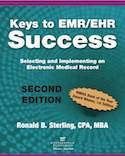 EMR Daily News: “Greenbranch Publishing announces the Second Edition of the breakthrough book for practices eager to minimize the costs, confusion and outright risks of choosing and implementing an Electronic Medical Record system. Keys to EMR/EHR Success: Selecting and Implementing an Electronic Medical Record, 2nd Edition by Ronald Sterling, CPA, MBA, paperback, 304 pages, ISBN: 978-0-9827055-0-6, list price – $139.00
The 1st Edition of Keys to EMR Success, was the HIMSS Book of the Year Award winner. In this revised Edition, nationally recognized expert Ron Sterling has included new chapters on EHR and Malpractice Risk, ARRA and Meaningful Use as well as detailed coverage of conversion issues for practices that have an old EMR.
“There is no question,†says Sterling, “that the selection and implementation of an EHR is a ‘bet-the-practice’ proposition. If you fail, you end up with more costs and greater frustration. Yet, few practices will be able to avoid implementing EHRs.â€
I looked for the book in the usual places, i.e. Amazon, Barnes and Noble, etc. I found the first addition, but no luck on the second. I even had hopes of finding it in electronic format for the Nook, Kindle or even the iPad. Nope. So if you want to purchase the book you’ll need to go directly to the Greenbranch Publishing website.
While contemplating purchasing this book something occured to me. With the length of time it takes to publish a book, how relative would this material be to the current state of EHR/EMR implementation? Technology is moving at lightning speed. Maybe it’s time to consider a new way of disseminating information like this. Just a thought.
-
We need a better system for medication reconciliation
Medication reconciliation is defined by JCAHO as “the process of comparing a patient’s medication orders to all of the medications that the patient has been taking. This reconciliation is done to avoid medication errors such as omissions, duplications, dosing errors, or drug interactions.†The process should be fairly straight forward, but it is actually very difficult and time consuming.
(more…) -
LIJ Health System to subsidize EMR deployment in New York
InformationWeek Healthcare: “The rollout is believed to be the nation’s largest EMR deployment to date, said North Shore LIJ CIO John Bosco. The health system serves five million people in the New York metro area, operating 14 hospitals, 18 long-term care facilities, five home-health agencies, dozens of outpatient centers, and a hospice network. Under the North Shore LIJ Electronic Health Record initiative, 1,200 staff physicians and 5,800 affiliated physicians will be offered subsidized EMR systems. EMR software will be provided by Allscripts and hosted using a cloud-based model by an unnamed Allscripts partner, Bosco said.” – The article goes on to say that North Shore LIJ will subsidize approximately 85% of the cost and allow physicians to keep any reimbursement earned under the ARRA. I’d say that is a pretty smart move on the part of LIJ. After all, getting physicians to use new technology is a difficult process. With this offer LIJ will get EMR use entrenched in the minds of approximately 7000 physicians in the New York area. It will be very interesting to see how things go over the next 5 years.
-
The American Recovery and Reinvestment Act is not without risk
The American Recovery and Reinvestment Act (ARRA) has created quite a flutter of activity in healthcare during the past several months. I can’t remember a time when something was such a popular topic. Everywhere you look, Twitter, Facebook, personal blogs, professional blogs, and so on are talking about how to demonstrate “meaningful use†and get their hot little hands on some cash.
While the idea is sound, the implementation has something to be desired. The overwhelming attention to the definition of “meaningful use†and the looming 2011 timeline has created some unwanted side effects to the ARRA. Hospitals have started throwing project plans in reverse for significant revision or throwing them out the window and starting over all together. Projects that may have been in the pipeline for months, or years, are now taking a back seat to the ARRA requirements. Project development and timelines are involved processes that are designed to work around several variables such as capital budgets, current software and hardware specs, and available human resources.
Many healthcare systems have yet to develop a plan to implement many of the requirements necessary to meet the ARRA “meaningful use†criteria. If a healthcare systems wasn’t ready to begin the process at any time over the past several years what makes the US government think they’ll be ready just because they say so? Is the infrastructure in place? Do they have the resources to not only implement, but support the new systems as well? These are all questions that people should be asking. I for one am disappointed in our facility as we have decided to immediately move forward with projects that weren’t slated for another 18-24 months. To make this happen other projects have been placed lower in the priority queue, creating a lack of resources that risk jeopardizing the quality of both implementations.
Healthcare systems should not be directed down a path that they feel unprepared to face. Doing so will only invite failure.
-
Hypatia research study only states the obvious
EMR Daily News: “Hypatia Research, LLC today released a report entitled “What Healthcare CIOs Need to Know About ARRA & EHR: Healthcare Technology Solutions & Service Providersâ€. Beyond the obvious value of centralized access to patient data, Hypatia Research discerned that electronic records systems provide health providers with multiple benefits: 1. ACCURACY& ERROR-CHECKS; 2. REPORTING; 3. MEDICAL NOWLEDGE-BASE; 4. NEAR-TIME ACTIONABLE INSIGHT” – If your CIO needs a research firm to understand what an electronic records system should provide, then you’re healthcare system is in deep doo-doo. This is all basic stuff that should have been on the radar long ago.
-
Yep, there’s an EMR app for the iPhone
Healthcare IT Consultant Blog: “It appears Caretools has thought of this, offering its iChart EHR for the iPhone, immediately available to anyone on the iTunes store. Before you scoff that it must be a limited-functionality, toy of an EHR, consider this: it offers ePrescribing, transmission of lab reports, ICD9-compliant billing code functionality, and a sophisticated menu system to quickly create SOAP and Procedure notes. It might not be CCHIT-certified (yet) or guarantee your eligibility for “meaningful use” funding, but at such a low price point, it could be a great way to get your physicians comfortable with standard EHR functionality.†– I took a quick jaunt over to the Caretools website and gave the application the once over. I think it’s pretty cool. At a mere $139.99 it’s about the cheapest EMR system you’re going to find on the market. You can read more about it at the iPhone Life website. Next thing you know, you’ll even be able to make phone calls directly from your iPhone.
-
Find a clinical trial using your iPhone
Healthcare IT Consultant: “Buoyed by the encouraging use of its PHR and Twitter based Clinical Trial matching service, TrialX is readying to release its iPhone application this month. This application, designed for doctors and patients, further underscores TrialX’s commitment to drive technology enabled consumer-driven healthcare. Using the TrialX iPhone App, doctors can search for clinical trials that their patients may be eligible for and email the results to the patients right away. They can filter clinical trials by location, medical condition, treatment, institution conducting the trial and other parameters. Similarly, patients and/or their loved ones can use this application to search for clinical trials. A video demo and screenshots of the new application are available at TrialX Mobile (http://trialx.com/mobile).” – You can search for clinical trials at the TrialX website as well. In addition, TrialX can identify clinical trials that may fit your condition based on your Google Health or MicrosoftVault profile. Take a second to browse around their site, it’s pretty slick.