As usual there were a lot of things that happened during the week, and not all of it was pharmacy or technology related. Here’s a quick look at some of the stuff I found interesting.
(more…)
Tag: EMR
-
“What’d I miss?” – Week of May 30, 2010
-
Cool Technology for Pharmacy – Practice Fusion EMR
Practice Fusion is a company based out of San Francisco that offers a free web-based electronic medical record (EMR), or is it electronic health record (EHR). To the best of my knowledge Practice Fusion was founded in 2005 and has been rapidly expanding ever since. Practice Fusion offers its EMR software free of charge in exchange for putting up with a few advertisements. The advertisements are non-obtrusive and don’t appear to get in the way of any of the application’s functionality. In fact, I didn’t even notice them. The best part of this revenue model is that it makes the software freely accessible to any physician that would like to use it. In addition, users are not required to install any new hardware of software. Very nice.
(more…) -
New edition of “Keys to EMR/EHR Success” available
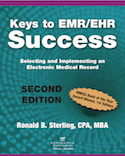 EMR Daily News: “Greenbranch Publishing announces the Second Edition of the breakthrough book for practices eager to minimize the costs, confusion and outright risks of choosing and implementing an Electronic Medical Record system. Keys to EMR/EHR Success: Selecting and Implementing an Electronic Medical Record, 2nd Edition by Ronald Sterling, CPA, MBA, paperback, 304 pages, ISBN: 978-0-9827055-0-6, list price – $139.00
The 1st Edition of Keys to EMR Success, was the HIMSS Book of the Year Award winner. In this revised Edition, nationally recognized expert Ron Sterling has included new chapters on EHR and Malpractice Risk, ARRA and Meaningful Use as well as detailed coverage of conversion issues for practices that have an old EMR.
“There is no question,†says Sterling, “that the selection and implementation of an EHR is a ‘bet-the-practice’ proposition. If you fail, you end up with more costs and greater frustration. Yet, few practices will be able to avoid implementing EHRs.â€
I looked for the book in the usual places, i.e. Amazon, Barnes and Noble, etc. I found the first addition, but no luck on the second. I even had hopes of finding it in electronic format for the Nook, Kindle or even the iPad. Nope. So if you want to purchase the book you’ll need to go directly to the Greenbranch Publishing website.
While contemplating purchasing this book something occured to me. With the length of time it takes to publish a book, how relative would this material be to the current state of EHR/EMR implementation? Technology is moving at lightning speed. Maybe it’s time to consider a new way of disseminating information like this. Just a thought.
-
“What’d I miss?” – Week of May 17, 2010
As usual there were a lot of things that happened during the week, and not all of it was pharmacy or technology related. Here’s a quick look at some of the stuff I found interesting.
(more…) -

Cool Technology for Pharmacy – eDoc Telemedicine System
 Telemedicine is one of those technologies that is either going to be unbelievably useful or a complete waste of time. Only time will tell. Recent articles like the one in Archives of Internal Medicine suggest that it may have a place in healthcare. Pharmacists may find telemedicine a useful tool for communicating with patients or physicians over great distances. I can see value in that.
While not specifically designed for pharmacy, the eDoc Telemedicine/EHR System is a cool piece of technology. For information to be useful it needs to be collected and made available at the point of care, which is exactly what this system does.
-
“What’d I miss?” – Week of February 28th, 2010
As usual there were a lot of things that happened during the week, and not all of it was pharmacy or technology related. Here’s a quick look at some of the stuff I found interesting.
(more…) -
Epic launches Haiku, an iPhone EHR application

“After three months of rumors, details surrounding Epic Systems’ partnership with Apple for a mobile phone-based electronic health record (EHR) application have come to light: Just a few days ago, Epic System’s iPhone application, called Haiku, became available on Apple’s AppStore. Haiku provides authorized clinical users of Epic’s Electronic Health Record with secure access to clinic schedules, hospital patient lists, health summaries, test results and notes. Haiku also supports dictation and In Basket access. Haiku works on both the iPhone and iPod touch,†according to the app’s description on the AppStore.â€
This is a very interesting turn of events as rumors regarding Apples new tablet entering the healthcare arena have been swirling around the internet. Could Haiku be the precursor to what we’ll see with the Apple tablet? I sure hope so.
-
We need a better system for medication reconciliation
Medication reconciliation is defined by JCAHO as “the process of comparing a patient’s medication orders to all of the medications that the patient has been taking. This reconciliation is done to avoid medication errors such as omissions, duplications, dosing errors, or drug interactions.†The process should be fairly straight forward, but it is actually very difficult and time consuming.
(more…) -
Cool Technology for Pharmacy
While not specifically related to pharmacy, this is very interesting. Stephen S. Hau, the founder of PatientKeeper in the 90’s, has created a new product called Shareable Ink. The product uses a digital pen on paper forms to capture handwriting. The information is transferred, via wireless connection, to a server where the information is digitized. The technology is not new per se, but the application to medicine in this way is.
(more…)